Part 3 Final Thoughts
“There is enormous inertia—a tyranny of the status quo—in private and especially government arrangements. Only a crisis—actual or perceived—produces real change. When that crisis occurs, the actions that are taken depend on the ideas that are lying around. That, I believe, is our basic function: to develop alternatives to existing policies, to keep them alive and available until the politically impossible becomes politically inevitable.”(117)
We have examined the operation of both markets and the political process. While both have shortcomings and there are legitimate roles for governments, the empirical evidence indicates that countries with more economic freedom and greater reliance on markets grow more rapidly and achieve higher income levels. (See Part 2, Exhibits 13 through 18.) Why is this the case? Incentives provide the answer. Markets create a powerful force for individuals and businesses to serve others, providing others with goods and services they value highly relative to cost. In a market economy, income is earned by helping others. If you want to earn a lot of income, you had better figure out how to help others a lot. Even though this attribute is seldom recognized, perhaps because people are unaware of it, markets motivate people to undertake actions that promote human progress. As Adam Smith noted nearly 250 years ago, the invisible hand of market prices directs self-interested individuals to undertake actions that promote the general welfare.
Political allocation is a fundamentally different alternative to markets. There are two general structures of democratic political regimes: presidential and parliamentary.
Regardless of whether the political system is presidential or parliamentary, political allocation of resources, even in democratic countries, often leads to a conflict between personal interests and the general welfare. Voters have little incentive to cast a well-informed vote. While the outcome of a political decision may affect the potential voter a great deal, what are the chances that any given vote will determine the outcome of an election? Using a rational “cost-benefit” analysis, it is amazing that anyone ever votes in an election. Voting as a civic duty is a generally accepted norm, but that does not mean that most voters make the effort to understand the issues confronting them. Surveys indicate, for example, that only 37% of Americans can name their representative in Congress.
To review, politicians and political parties, seeking to assemble a majority coalition, have a strong incentive to use debt financing, money creation, and hidden taxes to conceal the cost of resources extracted from the citizenry. The extracted resources can then be used to provide subsidies and other forms of favoritism to “buy” the support of various voting blocs. But political favoritism encourages business, labor, and other interest groups to shift resources away from productive activities toward rent-seeking designed to get more of the government favors. Political allocation may sound like a great idea, but the real-world results are unattractive. Such a system of allocation undermines economic efficiency and leads to interest-group politics, cronyism, excessive debt, and conflict among citizens.
What could be done to minimize the adverse consequences of democracy? What would a political structure more consistent with economic progress look like? These are complex questions, but key elements can be outlined.
- Political power must be both divided and constitutionally limited. As Lord Acton stated, “Power corrupts, absolute power corrupts absolutely.” As discussed in Element 3-10, successful governments apportion power among many competing entities, thus dividing power. For instance, the Constitution of Serbia, adopted in 2006, provides for decentralization, allowing for the establishment of autonomous provinces. In practice, however, there has been pressure on decentralization efforts, with the central government retaining substantial control over key areas such as finance and security. The Serbian case exemplifies the erosion of constitutional restraints over time. Thus, structural factors are also needed to constrain the centralization of government.
Checks and balances must serve to keep governmental power clearly divided across independent units. Governments typically have three areas of activity: a legislative branch that makes the laws, an executive branch that administers the laws, and a judicial (court) branch that interprets the laws. There are, however, a large number of institutional arrangements of these three basic functions. Ignoring monarchies, dictatorships, and military juntas (which may have the trappings of more democratic regimes but are, in fact, dominated by a single individual or small clique), the basic types of systems can be classified as:
- Parliamentary, in which executive power is held by a leader (typically called a “Prime Minister”) selected by the parliament, and parliament through the Prime Minister selects the cabinet of ministers. In such systems the Prime Minister serves at the will of the parliament and can be removed at any time. Such countries may have a figurative head of state (a monarch such as the King of England) or a President with limited powers (as in Germany).
- Presidential, in which the executive is selected directly by the voters and appoints his or her cabinet, typically subject only to approval by the legislative body. The United States is a good example of such a system.
- Semi-Presidential or Mixed, in which the voters select the President, who has limited but meaningful powers, but the Cabinet (ministers) is accountable to the parliament. Such a system can be found in France.
In examining parliamentary systems, specific institutional factors are important. Are elections run in small districts that elect a single member or in larger districts that elect multiple members? In the latter case, are seats allocated based on share of the votes and what is the minimum share necessary to enter the legislature?
The majority of post-communist transition countries (about 60 percent) have adopted a mixed system. Thirty percent have a parliamentary system and the remainder a presidential system. Over time, some countries—including Georgia in 2004, the Czech Republic in 2012, and Armenia in 2015—have switched from parliamentary to mixed systems. The powers of the President in these mixed systems vary a great deal across countries. Ukraine has been especially unstable, with revisions in the relative power of the President and Parliament in 1994, 1996, 2004, 2010, and 2014. Such instability of basic institutions clearly makes planning on the part of investors extremely difficult.
While there are advantages and disadvantages to all the above types, research suggests that presidential systems tend to have smaller governments. This may be because parliamentary systems are more likely to be coalition governments where multiple parties make demands for their constituents and priorities in order to support the government. On the other hand, parliamentary systems across the world seem to grow faster than presidential ones. In post-communist countries, however, presidential systems seem to have an additional disadvantage and be of larger size due to a tendency to centralize power, even to the extent of becoming autocratic states with only a façade of democracy.
There are several possible modifications that might improve the operation of parliamentary governments. Roger Myerson, who won the Nobel Prize in Economics in 2007, has suggested a practical structure that respects the concept of checks and balances. Given the extensive problems with corruption in transition economies, one logical solution is to divorce responsibility for operating the government from responsibility for investigating and prosecuting criminal activity. The former could be vested in the Prime Minister and the latter in the President’s office. The basic principle is that even in a long-established legal system, but especially in newly democratizing countries, having an independent power source in charge of investigating corrupt acts significantly reduces the ability of such actors to subvert justice.
Another possibly beneficial modification is to require larger majorities for approval of projects at higher levels of government. For example, while a simple majority could approve action at the local level, a three-fifths majority could be required for legislative approval at the provincial level and two-thirds for approval at the central level. This reform would strengthen local and provincial government and help to correct the tendency of power and control to flow toward the central government. Further, these supermajority requirements for approval at provincial and central levels would mean that broad agreement, not just a simple majority, would be required before a project could be undertaken at these levels. This would help to minimize another deficiency of unconstrained democracy: the ability of special interest groups to obtain government favors at the expense of taxpayers, consumers, and other citizens.
- The third branch of the government, the judiciary, must be an independent judiciary. While control of judicial appointments is important, it is not the only factor that contributes to the legal system functioning as a check and balance. Economic research has shown, over and over, that the independence of the judiciary is an important determinant of economic prosperity. It must be clear that by “independence” we mean real independence (de facto—or independence in fact), and not merely what is formally written in the law, but which entities can be avoided (de jure—or independence in law).(118)
- Debt financing must be restrained. Both economic analysis and recent history indicate the political process is biased toward debt because it enables politicians to increase spending without having to levy taxes, which impose a more visible cost on voters. If this bias is ignored, shortsighted politicians will predictably expand debt to levels that undermine prosperity, as they did in Greece. In many other countries, as in Greece, the issue of government debt has been a persistent concern, particularly in recent years due to economic challenges and financial instability. While there are provisions in the Greek constitution for fiscal responsibility and budgetary discipline, there are no explicit constitutional restrictions on government borrowing. This absence of constraints has contributed to the accumulation of significant levels of national debt, reaching alarming proportions. According to World Bank data, total central government debt accounted for 237.4% of Greece's GDP in 2021. Similarly, despite having different provisions in their constitutions for fiscal responsibilities, Albania and Croatia have experienced relatively high government debt-to-GDP ratios (91% for Croatia and 82.4% for Albania in 2021). Introducing a constitutional supermajority requirement at the parliamentary level to authorize government borrowing could be a potential solution to address this deficiency. For instance, requiring a two-thirds or three-fourths majority approval for borrowing decisions would impose a higher threshold for committing a country to additional debt.
- The Central Bank must be independent. As discussed in Element 2.5, money with a stable value is essential for the smooth operation of markets. That means controlling inflation. One disadvantage of a democratic system (although certainly one that does not offset its many advantages) is that politicians facing a contested election may make decisions that create benefits now but impose much larger costs in the future when they will no longer be in office. This brief time horizon can lead to high public spending without increased taxes to pay for such spending. Faced with this dilemma, politicians are often tempted to “pay for” their spending by ordering the central bank to create money. As we saw in Part 2, Element 5, excessive creation of money will lead to a high level of inflation. Monetary policymakers need to be made more accountable for their failure to maintain approximate price stability. One way this could be done is to require that those individuals in charge of monetary policy—the Board of Governors of the Central Banks—resign if they fail to keep the inflation rate within a specified range, for example, 0 to 3 percent. This type of provision makes monetary policymakers’ responsibilities clear and holds them accountable should they fail. New Zealand has already adopted policy along these lines. perhaps even hyperinflation. Both economic theory and past evidence say that by introducing uncertainty and changing incentives, making planning for the future difficult, such inflation will lower economic growth and citizens’ well-being in years to come. When Central Banks have the independence to resist pressure from politicians, the results have been lower and more stable prices and higher growth rates.
The judiciary must protect property rights. The philosopher John Locke, writing in the late seventeenth century, claimed that the right to own and use private property was a “natural right” and that the “preservation of property” was the “great and chief end” for which human beings created governments. Almost every constitution makes mention of the protection of property. Examples include the United States Constitution and The European Charter of Fundamental Rights, which says:
“Everyone has the right to own, use, dispose of and bequeath his or her lawfully acquired possessions. No one may be deprived of his or her possessions, except in the public interest and in the cases and under the conditions provided for by law, subject to fair compensation being paid in good time for their loss.”
Unfortunately, many of these high sounding principles are, as the saying goes, “not worth the paper they are printed on.” Governments frequently erode the protections of property. Phrases like “public interest,” “just compensation,” or “fair compensation” are subject to interpretation. Governments frequently use regulations to take or control private property without compensation, even though the property owner had not violated the rights of anyone. Courts have generally allowed such takings of private property if a legislative body deemed the action to be “in the public interest,” or that the taking did not deny the owner all uses of his or her property. This issue of effective taking (denying many uses of the property while technically not changing ownership) is especially problematic. What does it mean, for example, for an individual to “own” a piece of beachfront property if there is a regulation that it cannot be built on, or another that everyone must be allowed to use it? In sum, simply writing property rights into law or even constitutions is not sufficient to promote economic growth. Such rights must be credible and believed by potential investors. Economic research has shown that the effect of property rights on growth is much stronger when combined with judicial independence and a greater level of checks and balances in government structure.
There must be Freedom of Speech and a Free and Independent Press. While, as discussed above, checks and balances within the structure of government are important, they need to be supplemented with external monitoring. This is especially the case for what is known as “collusive corruption” in which both the payer of a bribe and the recipient are legally punishable, meaning that it is hard to gather evidence since no one involved has an incentive to betray the other. While there are more sophisticated statistical tests, the link between a free press and the overall effectiveness of government (and related greater economic success) is clear from a simple graph such as the one below. It is no wonder that in an authoritarian government, journalists are threatened with censorship, arrest, and even murder.
Exhibit 25: Press Freedom Reduces Corruption 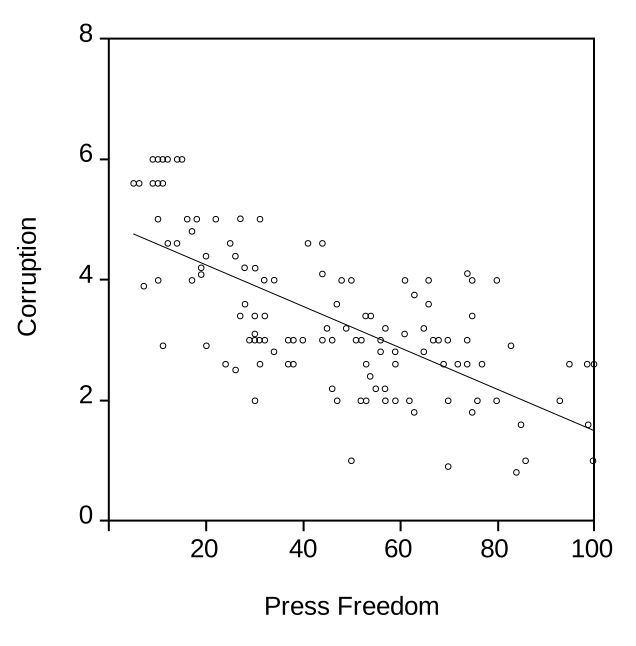
Source: Aymo Brunetti, Beatrice Weder, “A free press is bad news for corruption,” Journal of Public Economics, (2003), 87(7): 1801–1824, 10.1016/S0047-2727(01)00186-4.
Technological advances over the past 20 years have massively increased citizens’ ability to monitor governments and hold them accountable. Again, a simple graph makes the connection between internet penetration and low corruption obvious. (Here, Facebook is used simply as a stand-in for all social media.) Of course, this is a two-way street. Technological advances have made it much easier for totalitarian governments to keep track of what their citizens are doing (or even thinking).
Exhibit 26: Social Media Means Less Corruption 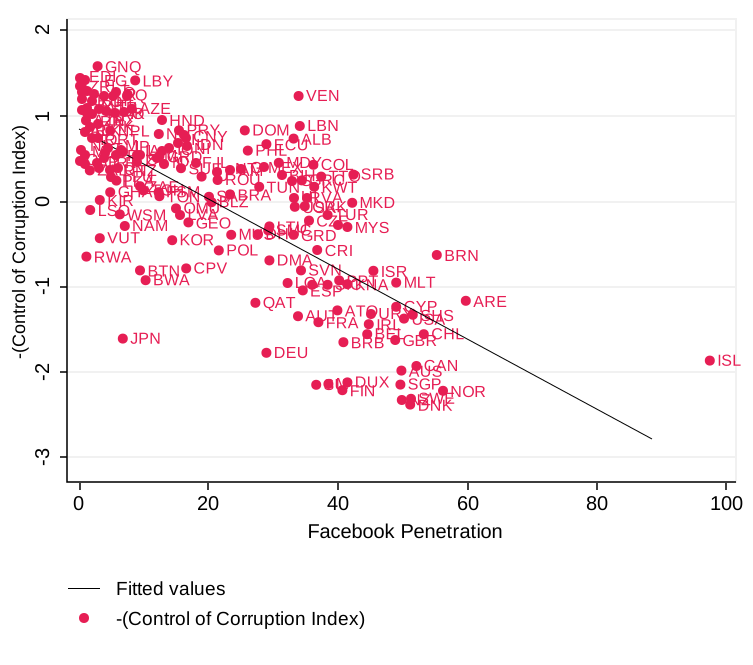
Source: C.K. Jha, & S. Sarangi “Does social media reduce corruption?”, Information Economics and Policy, Volume 39 (June, 2017): 60–71.
Press freedom means more than simply not suppressing outlets or threatening journalists. Governments controlling and using television for propaganda is a problem in many countries. An additional disturbing tendency is for rich politicians to purchase their own newspapers, television and radio stations. While interfering with private owners is always questionable, this is one area where sound public policy may well require limitations.
Freedom of Movement, Investment and Trade must be available to all citizens. The freedom of individuals to compete in business and engage in voluntary exchange activities is a cornerstone of both economic freedom and progress. Price controls, business and occupational entry restraints, laws restricting the exchange of goods and services across national boundaries, and other government regulations that restrain trade are not sound economics. Occupational licensing (which requires government approval to engage in an occupation such as, to take an extreme but real example, hair braiding) is a major anticompetitive device that restricts work opportunities, including those of many of the least well-off members of society. When there is concern about protecting the public, certification (which provides information about an individual’s training but leaves consumers free to evaluate the relevance of that training) provides a superior option. With certification, buyers are provided with the information to make sound choices without closing off the opportunity for others to prove that they are capable providers. Predictably, licensing will be used to restrain trade and provide existing suppliers with monopoly power. The freedom to trade is a basic human right, just like freedom of speech and freedom of religion. There is no reason citizens should not be permitted to buy from, and sell to, whoever will give them the best deal, even if the trading partner lives in another country. Somewhat surprisingly, while reciprocal free trade (where both partners are open to buying and selling from each other) is clearly advantageous, the consensus among economists is that reciprocity is not essential. In almost all cases a country will improve the lives of its citizens if it drops barriers to free import of goods, regardless of the policy of its trading partners. The logic of such “unilateral free trade” can be seen in a quotation from Joan Robinson (1903–83), one of the most original and prolific economists of the last 100 years:
“Even if your trading partner dumps rocks into his harbour to obstruct arriving cargo ships, you do not make yourself better off by dumping rocks into your own harbour.”
Public discussion often tries to analyze freedom of trade, freedom of movement, and freedom of investment as separate topics. They are not. If workers are paid less in one country than another, all three channels will come into play. Workers will try to move to the higher wage area, investors will come to the lower wage country to take advantage of cheap labor, and goods produced using this labor will be less expensive in global markets. Blocking any one of these channels will only increase the pressure on the others.
EXTERNAL ANCHORS ARE CRITICAL. Voters, like all economically rational people, make decisions by comparing costs and benefits. Politicians, as we have already discussed, often have very short time horizons, ending at the next election. This disconnect creates difficulty in adopting policies that impose current costs in return for much larger long-term benefits. This time inconsistency makes it hard for politicians to make believable policy commitments. Leaders may also be subject to pressure from powerful vested interests to adopt policies that favor insiders at the expense of the public at large. One possible solution is for far-sighted leaders to limit their ability to respond to pressure by joining an international organization that requires good policies as a condition of joining or continuing membership. There are many such organizations. The European Union (EU) imposes requirements of a low budget deficit and a limit to total level of government borrowing. It also requires members to adopt a set of common legal rules (called the Acquis Communautaire). While some EU policies (for example, farm subsidies under the Common Agricultural Policy) may not be beneficial or are even contrary to sound economics, they are typically far better than those that might have been adopted by many post-communist countries without the incentive of prospective EU membership. Countries with a reasonable expectation of joining the EU made many painful reforms that ultimately benefited their citizens.(119)
Other organizations that could have a similar positive influence include the North Atlantic Treaty Organization (NATO), the World Trade Organization (WTO), the European Court of Human Rights, the Organization for Economic Cooperation and Development (OECD), and the International Centre for Settlement of Investment Disputes (ICSID). The International Monetary Fund (IMF) is particularly important in inducing governments to adopt growth-enhancing governmental policies. Countries tend to turn to the IMF for assistance when excessive government spending has created currency crises where international credit markets are no longer accessible to finance even more government. Only pressure from the IMF and the European Central Bank (ECB) persuaded the Greek government to adopt necessary reforms.
Even external rankings by organizations that do not require membership can have a positive influence on government performance. Georgia, for example, takes immense pride in being ranked among the top 10 countries in the World Bank’s “Ease of Doing Business” index and government ministers are held accountable for reforms that improve this ranking. An example would be the Greek debt crisis of 2010–2018.
These principles will provide people with protection against the oppressiveness of centralized power and help bring government spending and borrowing under control, while limiting the inclination of politicians to serve special interests and to undermine personal freedom. Taken together, the changes would be a positive step toward the restoration of government based on mutual agreement rather than the power to plunder. We have no doubt that they would assure growth and prosperity for future generations.
We are aware that structural changes like those outlined above are unlikely to be adopted universally or in the immediate future. We also recognize that, other than a few public-choice economists, most people do not even think about the problem of how the political process works and what might be done to make it work better. The media and opinion leaders focus on who is gaining political power and generally ignore the adverse consequences of how that power is exercised.
Thus, getting people to think seriously about the structure of government and what might be done to improve its operation will be a challenge. But economic analysis tells us that even the most democratic countries are on unsustainable paths. If change does not occur, a crisis is likely and that may create an opportunity for constructive change. (See the quotation from Milton Friedman at the beginning of this element.)
It is of vital importance when thinking about the structure of government to distinguish between the form and the reality. Many countries have a government structure that looks like the ideal we have been discussing. They have multi-candidate elections, nominally independent legislatures and judiciaries, and multiple levels of government from national to municipal. Yet, they are not truly responsive to the will of their citizens. Examples abound among post-communist countries as well as post-colonial countries in Africa and Latin America.
Such exploitive governments are rare, however, in well-established free market economies. Economic freedom is hard to reconcile with political repression.(120) As populations become assured of day-to-day survival, they tend to focus more on abstract issues such as political and religious freedom and gender equality. Entrepreneurial discovery is a powerful force for human progress.
We have emphasized the role of markets and exchange, as opposed to governments, in ensuring social benefits because all too often this difference is misunderstood. We are well aware, however, that not all the actions individuals undertake to serve others are compensated through markets. Individual rewards frequently come in forms other than money. Indeed, the division we have drawn between the public and the private (market) sector is incomplete. There is also what economists call the third sector including charities, nonprofit organizations, social enterprises, and community groups that deliver essential services, help to improve people's wellbeing, and thus, contribute to economic growth. This third sector is often of considerable size in developed economies. Indeed, one recent estimate put the number of unpaid volunteers serving society in Europe at the equivalent of more than 15 million full-time workers.
Evidence about the relationship between the third sector and the first (private) and second (public) sectors is mixed but tends to show that a more successful private sector increases charitable cash donations while having a negligible effect on donations of time. It is clear, however, that expansion of the public sector crowds out private response to social or other problems. Evidence from the US and Canada indicates that government grants tend to reduce private support for nonprofit organizations by up to 75 percent. Grants to individuals tend to reduce work effort and family formation among recipients. On the other hand, the evidence is that a government that better fulfills its basic functions of reducing unemployment and inflation and promoting economic growth enhances the tendency of citizens to volunteer both money and labor.
Indeed, Elinor Ostrom became the first woman to win the Nobel Prize in economics for her pioneering work showing that voluntary, community organizations perform better than either pure markets or government policies in solving problems of public goods.
Sections 2 and 3 focused on national prosperity. Looking ahead, Section Element 4 will focus on personal prosperity. It will consider practical strategies to help you better prepare for the future and achieve a more prosperous life. As we do so, we urge you to keep in mind the words of Albert Schweitzer:
“I do not know what your destiny will be. Some of you will perhaps occupy remarkable positions. Perhaps some of you will become famous by your pens or as artists. But I know one thing: the only ones of you who will be really happy are those among you who have sought and found how to serve.”
Often markets will, as we have emphasized, reward such service, but on other occasions the rewards will be in the joy and satisfaction you receive from helping others.