Part 2: Seven Major Sources of Economic Progress

Elements:
- The Legal System.
- Competitive Markets.
- Sensible and Limited Regulation.
- Efficient Capital Markets.
- Monetary Stability.
- Prudent Fiscal Policy.
- Free Trade.
Economic Growth and Development: The Historical Record
Robert Lucas, the 1995 Nobel laureate, stated, “Once you start thinking about economic growth, it is hard to think about anything else.”(18) Why do Lucas and many other economists place so much emphasis on economic growth? Because the growth of real GDP per capita is the only way for a nation to achieve higher income levels and living standards.
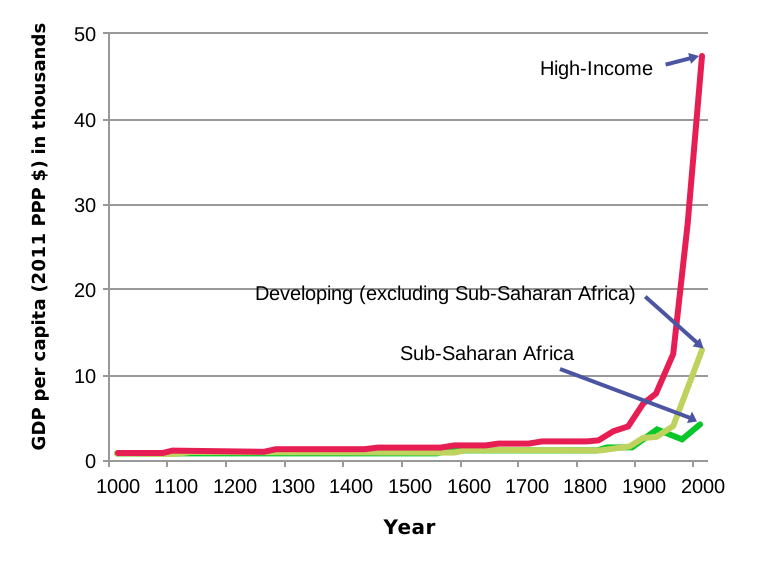
Throughout most of human history, economic growth has been extremely rare. The late Angus Maddison, an economist for the Organization for Economic Cooperation and Development (OECD), is widely recognized as the leading authority on historical income figures. Exhibit 5 presents his estimates of per-person income during the past thousand years. (Income is expressed in 2011 dollars.) Data are presented for the West—twenty-one high-income countries of Western Europe, North America, Oceania, and Japan—along with the parallel figures for developing countries.(19)
Sources
J. Bolt and J. van Zanden, “Maddison Style Estimates of the Evolution of the World Economy: A New 2020 Update,” Groningen Growth and Development Center, October 2020, www.rug.nl/wp15.pdf;
J. Bolt, R. Inklaar, H. de Jong, and J. van Zanden, “Rebasing ‘Maddison’: New Income Comparisons and the Shape of Long-Run Economic Development” (Maddison Project Working Paper No. 10, 2018), www.rug.nl/gd174.pdf;
Look at the income figures of Exhibit 5 prior to 1800. There was virtually no change in income per person in either the West or the rest of the world during the eight hundred years before 1800. During this time, people throughout the world worked hard for fifty, sixty, and seventy hours per week to obtain enough food and shelter for subsistence. They had a constant struggle for survival, and many lost the battle. Even in 1800, living standards were not much different from those a thousand years earlier, or even two thousand years earlier during the time of ancient Rome. Every time incomes rose a bit, what Thomas Malthus called the “iron law of population” kicked in and incomes for the vast majority of humanity fell back to substance levels.(20)
In the West, this bleak economic story began to change around 1800. In your history and civics classes, you were probably told how the Industrial Revolution changed the world. Newly developed machines, technological improvements, and capital investment resulted in higher income levels and living standards.
This Industrial Revolution certainly made a difference in the West. As Exhibit 5 shows, per-person income in Western Europe, North America, and other parts of the West rose dramatically, from $1,460 in 1820 to $2,506 in 1870 and $5,413 in 1913. By 1950 the per capita income in these regions had soared to $8,464. Thus, in the West, income rose from $4 per day in 1820 to $23 per day in 1950, an increase of nearly 500 percent in 130 years. These figures are based on 2011 prices so they have accounted for prices changes over time, meaning that consumers in the West in 1950 were able to buy over 5 times as much food, clothing and other goods as they were in 1800.(21)
But only about 15 percent of the world’s population live in developed countries, and the change was much less transformative in other regions. From 1820 to 1950, the gross domestic product (GDP) per person in the developing countries in Asia, Latin America, the Middle East and North Africa rose from $816 (a little more than $2 per day) to $1,426 (approximately $4 per day), again in 2011 dollars. This is an average growth rate of only half of a percent per year. The $4 per day income level of the developing countries in 1950 was still near the subsistence level and approximately the same as that of the high-income countries in 1820. Sub-Saharan Africa was even poorer, with many averaging a per capita GDP of close to $1 dollar a day, a figure that had not changed in hundreds of years.
In other words, while the Industrial Revolution generated growth in Western Europe, North America, Oceania, and Japan, its impact on the 85 percent of the population living elsewhere was minimal. People in some of these countries did a little better during this period than prior to 1800, but not much. Now look at what has happened during the past half century. Since 1950, something like a second economic revolution has occurred, and this time it has moved through the entire world. For the first time in history, the rest of the world has also achieved sustained economic growth and income levels well above subsistence. The latest wave of rising per-person real-income levels occurred first in developing countries outside of sub-Saharan Africa, but more recently, sustained growth has also occurred in even the latter region. As Exhibit 5 shows, the real per capita GDP (adjusted for inflation) of the developing countries outside of sub-Saharan Africa rose from $1,698 in 1960 to $11,820 in 2018, a whopping increase of 596 percent. This increase in just 58 years was even larger than the growth of per capita GDP in the West during the 130 years following 1820. Moreover, during 2000–2018, the per capita GDP of sub-Saharan African countries rose by 67 percent in just 18 years.(22)
After a bleak period at the start of the transition, post-communist countries have also seen rapid growth. Between 2002 and 2022, Azerbaijan, Armenia, and Georgia experienced remarkable economic growth, with their real GDP per capita more than tripling. Indeed, in 2022 alone each of these countries saw growth rates in excess of 10%. In the same period, Kazakhstan, Mongolia, Tajikistan, and Uzbekistan also saw substantial progress, with their real GDP per capita more than doubling.(23)
As history illustrates, economic growth does not happen automatically. What are the key sources of economic growth and human progress? Why do some countries grow and achieve high levels of income while others stagnate? How can the pattern of economic growth shown in Exhibit 5 be explained?
The modern view of development recognizes that institutions and policies exert a major impact on growth. By institutions we mean the rules, laws, and customs that guide behavior. This section will analyze the key institutional and policy factors underlying the growth process and how they lead to differences among nations. While there is no one single formula for economic growth, we now have a pretty good idea of what helps and what should be avoided.