Element 4.7: Put the Power of Compound Interest to Work
“Compound interest is the most powerful force in the universe.”(136)

In Element 4.3, we emphasized the importance of budgeting regularly, saving habitually, and spending your money effectively. There are two major reasons for starting earlier rather than later. First, as discussed, those who yield now to the many excuses not to start budgeting, saving, and spending wisely will have a tough time doing so later. But in this Element, we want to talk more about the second reason to begin saving right away: the big payoff that comes from starting early. A small head start in your savings program leads to a substantial increase in the payoff when the savings are directed into investment. Recall the example in Element 4.3 of the additional retirement wealth a young person could have by saving a modest amount from age 22 to 30. Giving up just a little less than €9,500 in purchasing power for those nine years can easily add over €150,000 to retirement wealth at age 67. The key to converting a small amount of money now into a large amount later is to start saving immediately to take full advantage of the “miracle of compound interest.”
Compound Interest is not really a miracle, but sometimes it seems that way. While easy to explain, the results are utterly amazing! Compound interest is simply earning interest on interest. If you do not spend the interest earned on your savings this year, the interest will add to both your savings and the interest earned next year. By doing the same thing each year in the future, you then earn interest on your interest on your interest, and so on. It may not seem like much, and for the first few years it does not add that much to your wealth, but before too long your wealth begins growing noticeably, and the larger it becomes, the faster it grows. It is like a small snowball rolling down a snow-covered mountain. At first its size increases slowly, but as each extra bit of snow adds to the snowball’s size, it allows even more snow to be accumulated, and soon it is huge and growing rapidly.
The importance of starting your savings program early is explained by how compound interest sets the stage for this later accelerating effect. The savings you make right before retirement will not add much more to your retirement wealth than the amount you save—a little but not much. The snowball that starts near the bottom of the mountain will not be much bigger when it stops rolling. Therefore, the sooner you start saving, the more time that early savings will have to grow, and the more dramatic the growth will be.
Consider a simple example. Assume a 16-year-old (let’s call her Maya) is reading this book and decides to act on some of what she read. She sets goals, creates a budget, and strategically makes decisions in such a way that she reduces her spending by €7.50 per day. To put this amount in context, €7.50 is about the cost of a “Happy Meal” at McDonalds in Albania or Armenia. (Or, if Maya is a bit more self-destructive, a pack of Marlboros and a Heineken.) We use the €7.50 a day figure as a small number. With a good afterschool job, Maya may be able to do this every day, but what if she ordered half as much or only ordered three days a week? She could then save a bit more every week. If she can’t, she can make up by adding extra when she has extra (maybe from asking for a contribution rather than some trinket for her birthday). Our point is that if our teenager alters her decisions just a little, she will save a non-trivial amount save a year. Suppose that instead of spending this amount on her indulgences, Maya invests it in a mutual fund that provides an annual rate of return of 7 percent in real terms—that is, after adjusting for inflation. This 7 percent return is approximately equal to the annual rate of return of the Standard & Poor’s (S&P) 500 Index, an index of the five hundred largest U.S. firms that mirrors the performance of the overall stock market.) This 7 percent average return is even a bit less than that of the DAX (Deutscher Aktien Index), Germany’s equivalent index over the 50 years to 2024. Both calculations assume that dividends are reinvested. It is also very important to understand that these long-term averages mask considerable year-to-year variation. There have been years when the S&P or the DAX rose by over 40% as well as others when they fell by over 40%. If your time horizon is short (say, next year’s tuition or an upcoming wedding), it is better to put your money in a bank. Stock markets are for money that you will not need for some time so the variations will even out. We will discuss stock market investments in more detail in a future section.
As Exhibit 28 illustrates, if Maya keeps this up for ten years, when she is 26 she will have accumulated €37,823 from savings of €27,375. Not bad for a rather small sacrifice. If Maya’s savings were a spacecraft this is just lift off; the payoff from compound interest is merely getting started. If Maya keeps this savings plan going until she is 36, she will have €112,225 from savings of €54,750. Continuing until she is 46 will find her with an expected €258,586 from savings of €82,125. And now the afterburners start kicking in. By the time Maya is 56 she will have €546,501 from saving contributions of €109,500. As Exhibit 28 shows, if she retires at age 60, she can expect to have €728,506 saved from direct contributions of €120,450. If she retires at age 67, she will have €1,193,512 from direct contributions of only €139,613.(137) Thus, by choosing a slightly different spending pattern and investing the funds, Maya accumulates nearly €1.2 million in retirement benefits—and this figure is in euros with today’s purchasing power. If Maya then invested this money in what is called an annuity, she would have €70,000 in income every year for the rest of her life!(138)
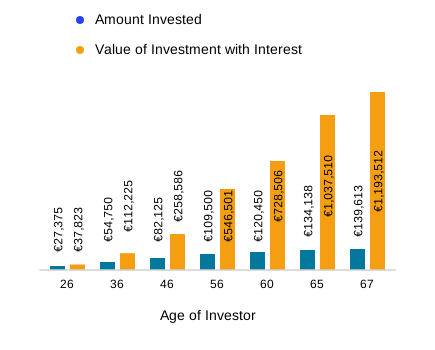
Source: Authors’ calculations. Assumes altering spending habits to save €7.50 per day and earning interest of 7 percent per year.
Alternatively, consider what would happen if Maya continued her original spending habits from age 16 to 26, then altered her habits and started allocating the €7.50 per day into an investment fund. It is good that she made the changes, and she will still benefit from the savings. But by postponing her investing program by ten years, instead of having €1,193,512 at age 67 Maya will have only €587,494. Delaying a 51-year investing program by ten years costs Maya €606,018 at retirement!
You don’t have to give up much to enlarge your savings. Making small sacrifices in consumption can yield powerful results. Instead of buying the premium cup of coffee every morning, purchase the generic one or make a cup at home. Instead of eating lunch at a restaurant every day, bring your lunch one or two days a week. Skip the soft drink or beverage at a restaurant and drink water. Carpool or take the bus to work to save gas money (or even walk and also save the gym membership). Everyone can find minor changes in their consumption habits to save money.
Video:
Again, our point is not that you should live a miserable life of austerity and sacrifice so that you can be rich when you retire. Where is the advantage in becoming rich in the future by living in poverty until the future arrives? Instead, we are stressing that anyone can have a high standard of living and still accumulate a lot of wealth, because it does not take much savings to get a big payoff. Of the €1,193,512 Maya accumulated by altering her spending, only €139,613 came from reducing her consumption. Indeed, people who save and invest will be able to consume far more than those who do not. At retirement—or sooner—Maya can start spending her wealth and end up having much more than if she had never saved.
All it takes is an early savings program, a little patience, knowing how to get a reasonable return on your investments (see Elements 4.8 and 4.9), and taking advantage of the power of compound interest.
There is a very important reason we have couched the analysis in this element in terms of saving for retirement, since saving for retirement is something that almost everyone should have as a goal. Of course, you may very well want to take the quarter of a million Euros you have saved by your mid-40s to start a business, believing you can grow your business faster than the stock market. Even if you work for a salary all your life, however, you will need to have substantial savings when you no longer want (or are able to) work.
Many young people think “Oh, I’ll have a government pension plan that will take care of me.” This is dangerous thinking. Throughout the world, except in a few very rich countries, public pensions pay only a fraction of a country’s poverty income. In several transition economies in 2024 the average payment was around $100 a month. While these pensions may get somewhat more generous as a country grows, there is another sword of Damocles hanging over them. Unlike private pensions where you save from your earnings and that money waits for you to need it, public pensions are of a form known as a pay as you go system. In other words, pensions for those retired at any time are paid by taxes levied on those working at that same time. Two factors will put great stress on these systems as current young people age. First of all, people are living longer. Over the past several decades the average future life expectancy of a worker retiring at age 65 in a developed country has increased by several years. While the effect of this on a country’s ability to support a pay-as-you-go pension plan can be mitigated by forcing workers to delay retirement, another looking problem is not so easy to avoid. Demographers agree that for a country’s population, and age distribution, to stay constant the average woman in each birth cohort should have approximate 2.1 children.(139) Any fewer and over an extended time the age structure of the population will look like an inverted pyramid—wider at the top and supported by a narrower base.
Among the post-communist world, only a couple of countries in Central Asia are above replacement rate fertility levels. All the rest are below, often far below, meaning that eventually populations will start to shrink and each worker will have to support an ever-growing number of retirees under a pay-as-you-go public pension system. It also means that each elderly person will have fewer and fewer younger family members to rely on. This is why taking personal responsibility of saving for your own future is important and that the earlier you start doing this the better for you.