Element 3.7: Avoid Subsidies Not Based on Economic Logic
“The tool of politics (which frequently becomes its objective) is to extract resources from the general taxpayer with minimum offense and to distribute the proceeds among innumerable claimants in such a way as to maximize the support at the polls. Politics, so far as mobilizing support is concerned, represents the art of calculated cheating or, more precisely, how to cheat without being caught.”(100)
There are two ways individuals can acquire wealth: by production or by plunder. People can get ahead by producing goods or services of value and exchanging them for income. This positive-sum method of acquiring income helps both trading partners and enhances the wealth of society. But sometimes people will try to get ahead through plunder, taking from others without their consent. Of course, the victims of plunder will lose what the plunderer gains. In addition, where plunder is feared, potential victims will employ resources to defend themselves against it. In a society in which burglary is common, for example, people will buy more locks, use more security services, demand more police, and even design their homes in ways to discourage theft. The costs imposed on those plundered (or fearing plunder) will include both their losses and their investments in protection than the gains obtained by those engaging in plunder. When we talk about plunder here, of course, it may not be physical theft. It could be theft of intellectual property, for example, and the costs of protection might be fees paid to lawyers. In contrast to positive-sum exchange activities, plunder is a negative-sum activity. It not only fails to generate additional income but also consumes resources, reducing the wealth of the society.
Video:
Governments promote economic prosperity when they encourage production and exchange and discourage plunder. When effective laws and their enforcement make it difficult to take from others, either via crime or use of political action, few resources will flow into those actions. Moreover, the resources employed defending against plunder will also be small.
In the modern world, however, governments themselves have often become major plunderers. Governments provide subsidies and favors to some by taking resources from taxpayers, shuffling budget allocations and borrowing. While technically not theft because it is done through laws, it is still a negative-sum activity that harms the citizenry and slows economic growth.
Video:
In the EU, subsidies and other transfers amounted half of total budget expense in 2021.(101) In France, for example, subsidies and other transfers account for about 65 percent of total expenses. Social Protection subsidies comprise the bulk of the transfers (about 39 percent of the total expenditure).(102) Subsidies and other transfers as a percent of total expense in other selected countries are summarized in Exhibit 22.
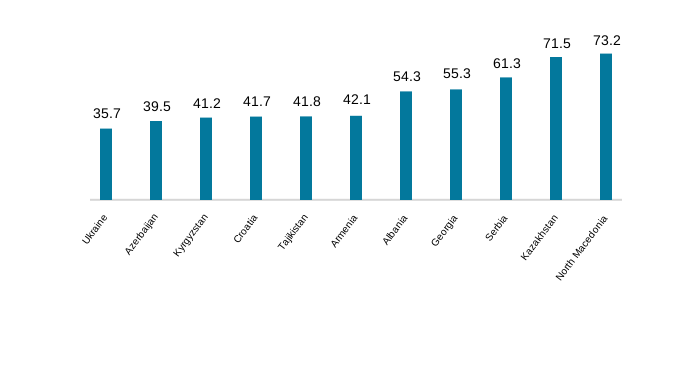
Source: International Monetary Fund, Government Finance Statistics Yearbook and data files.
Subsidies and government favoritism are dangers to both political democracy and economic efficiency. There are several reasons why this is the case.
First, the subsidies encourage businesses to spend more time searching for favoritism in central governments and less time developing better and more economical products. Predictably, an increase in the availability of government favoritism will strengthen the power of special interests and encourage deception. To obtain more government funds and gain advantages relative to rivals, businesses and other favor-seekers will tie their interests to popular objectives, such as increasing employment, reducing poverty, improving environmental quality, and lessening dependence on foreigners. Even when their actions are motivated by financial gain and political power, interest groups will have a strong incentive to claim they are seeking to achieve broader, more popular objectives than is actually the case.
Second, subsidies to some firms and sectors distort market prices, placing others at a disadvantage. Some of the unsubsidized firms will be driven out of business or fail to enter the market because they can’t compete with subsidized rivals. Alternatively, businesses may move to another country without these barriers. For example, firms using a great deal of sugar in their production process have moved to Canada to avoid the artificially high price of US sugar created by subsidies. The result is a diversion of resources from businesses dependent on market consumers to those favored by politicians.
Third, and perhaps most important, the subsidies and favoritism will create an improper, unethical relationship between business and political officials. “Corporate welfare” and “Crony capitalism” are thereby encouraged, and the interests of taxpayers are compromised. The greater the degree of corporate welfare (that is, the more numerous the government subsidy programs directed toward business), the greater the flow of resources into favor-seeking activities. (Note: Economists often use the term rent-seeking to describe this favor-seeking by businesses and other groups.) As politics replaces markets, the economy will be increasingly characterized by cronyism, corruption, counterproductive activities, and economic growth will fall below its potential.
Video:
Increasingly, the governments of high-income democratic countries (and not only, as demonstrated by Exhibit 22) use taxes and borrowing to provide subsidies and other favors to specified voting blocs in exchange for political contributions and support. A statement widely attributed to 19th century Scottish lawyer and historian Alexander Fraser Tytler, argues:
“A democracy cannot exist as a permanent form of government. It can only exist until the voters discover that they can vote themselves largesse from the public treasury. From that moment on, the majority always votes for the candidates promising the most benefits from the public treasury with the result that a democracy always collapses over loose fiscal policy.”(103)
Despite frequent issues of corruption in the post-communist transition economies, as of 2023 their debt levels could still be brought under control, given the political will. Exhibit 23 shows the share of government revenue required to pay interest on government debt for various transition and middle-income countries.
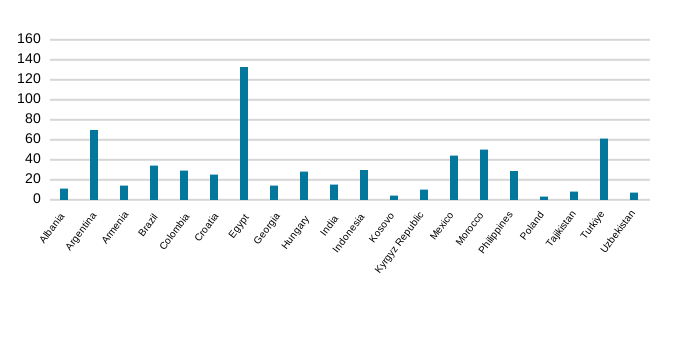
Source: Debt Service watch Database, www.development-finance.org, Retrieved April 9, 2024
The warning is clear, however. Once businesses and other interest groups become heavily involved in providing politicians with support in exchange for subsidies and favoritism, these harmful influences will be very difficult to restrain. As government favoritism grows and both the recipients and politicians become more dependent on it, transfer spending will grow and resources will move away from productive activities. Moreover, deceitful behavior, unethical relations, and even corruption will become commonplace. There will be upward pressure on taxes, budget deficits will expand even further, and the politically manipulated economy will stagnate. Unless the constitutional protection of property rights and limitations on the spending, subsidizing, and borrowing activities of government are in place and enforced, democratically elected politicians will increasingly enact programs that waste resources and impair the general standard of living.