Element 3.5: Adopt Rules to Limit the Influence of Special Interests
“When buying and selling are controlled by legislatures, the first things bought and sold are legislators.”
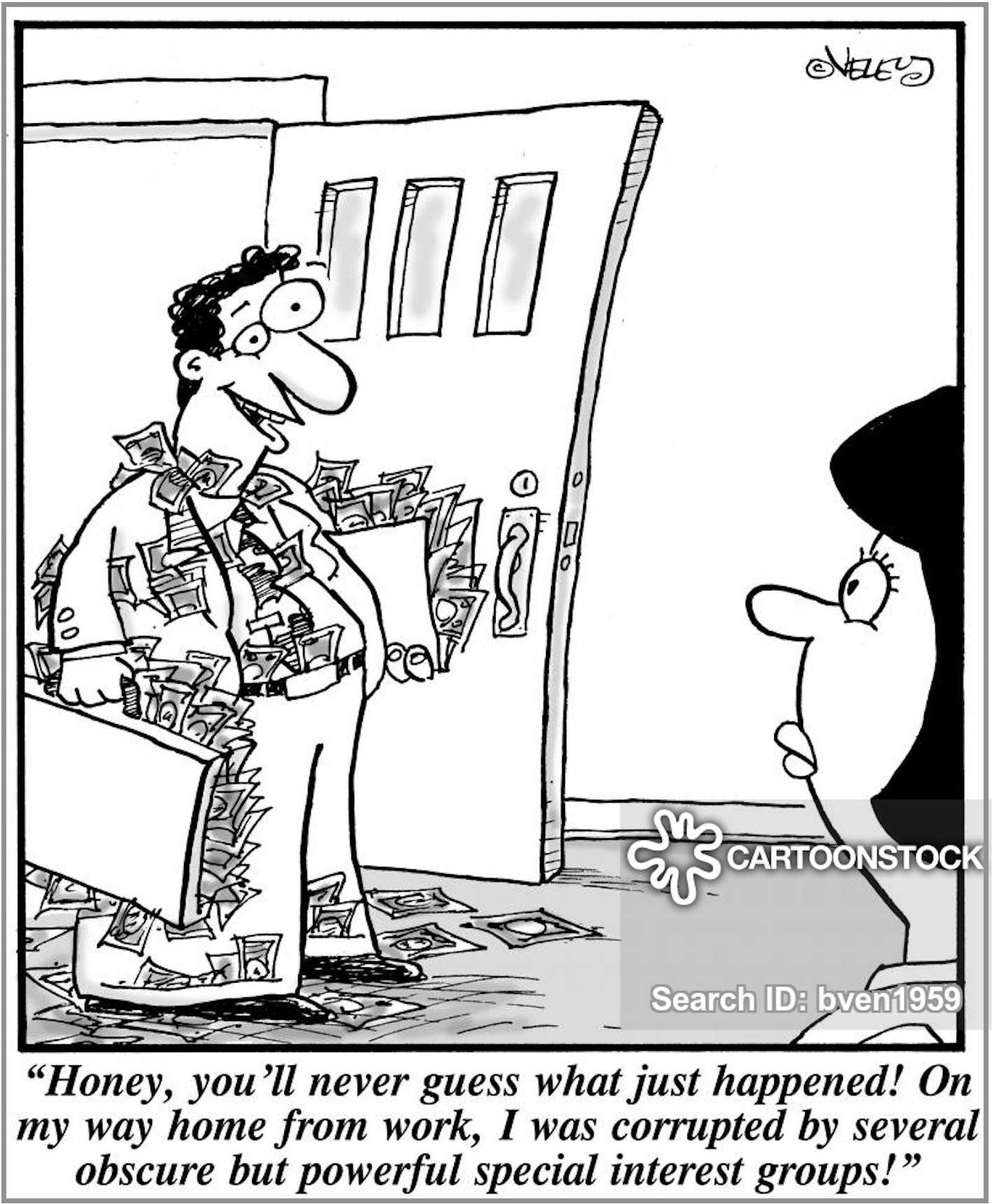
Democratically elected officials can often benefit by supporting policies that favor special-interest groups at the expense of the general public. Consider a policy that generates substantial personal gain for the members of a well-organized group (for example, an association representing business interests, members of a labor union, or a farm group) at the expense of the broader interests of taxpayers or consumers. While the organized interest group has fewer members than the total number of taxpayers or consumers, the personal benefits derived by their members from the favored policy are generally large. In contrast, while many taxpayers and consumers are harmed by the policy, the cost imposed on each is small, and the source of the cost is often difficult to identify.
Because the personal stake of the interest-group members is substantial, they have a powerful incentive to form alliances to let candidates and legislators know their position on a particular issue. Many interest-group members will decide who to vote for and who to support financially almost exclusively based on a politician’s stand on a few issues of special importance to them. In contrast, as the rational ignorance effect illustrates, the bulk of voters will be generally uninformed and they will not care much about the harm from the special-interest issue, given its minimal impact on their personal welfare.
If you were a vote-seeking politician, what would you do? Clearly you would not get much campaign support by favoring the interests of the largely uninformed and unorganized majority. But you can get vocal supporters, campaign workers, and most important, campaign contributions by favoring the position of the special interest. In this age of media politics, politicians are under strong pressure to support special interests, tap them for campaign funds, and use the contributions to project a positive candidate image on television and the internet. Politicians unwilling to play this game—those unwilling to use the government treasury to provide well-organized interest groups with favors in exchange for political support—are seriously disadvantaged. Given these incentives, politicians are led as if by an invisible political hand to reflect the views of special-interest groups, even though this often leads to policies that, summed across all voters, waste resources and reduce their living standards. Economists refer to this bias in the political process as the special-interest effect.
The power of special interests is further strengthened by logrolling and pork-barrel legislation. Logrolling is the practice of vote trading between politicians to get the necessary support to pass desired legislation. Pork Barrel legislation is the bundling of unrelated projects benefiting many interests into a single bill. Both logrolling and pork-barrel legislation often make it possible for counterproductive projects benefiting concentrated interests to gain legislative approval.
Exhibit 20 illustrates how pork-barrel politics and vote-trading reinforce the special-interest effect and lead to the adoption of counterproductive projects. In this simple example, a five-member legislature is considering three projects: (1) building a sports stadium in District A; (2) construction of an indoor rainforest in District B; and (3) subsidies for ethanol that generate benefits for the corn farmers of District C. For each district, the net benefit or cost is shown—that is, the benefit to the district minus the tax cost imposed on it. The total cost of each of the three projects exceeds the benefit (as shown by the negative number in the total row at the bottom of Exhibit 20). Therefore, each is counterproductive.
If these counterproductive projects were voted on separately, each would lose by a four-to-one vote because for each option, only one district would gain and the other four would lose. When the projects are bundled together, however, through either logrolling (representatives A, B, and C could agree to trade votes) or pork-barrel legislation (all three programs could be incorporated into a single bill), they can all pass even though all are inefficient. This can be seen by noting that the total combined net benefit is positive for representatives A, B, and C. Given the weak incentive for voters to acquire information, those harmed by pork-barreling and other special-interest policies (such as D and E, in this case) are unlikely to even be aware of them. Thus, the incentive to support special-interest projects, including those that are counterproductive, is even stronger than is implied by the simple numeric example of Exhibit 20.
Exhibit 20: Trading Votes and Passing Counterproductive Legislation
| Net Benefits (+) or Costs (-) to Voters in Equal Size Districts | ||||
| Voters of District | Sports Stadium | Indoor Rainforest Project | Ethanol Subsidy | Total |
| A | $100 | -$30 | -$30 | $40 |
| B | -$30 | $100 | -$30 | $40 |
| C | -$30 | -$30 | $100 | $40 |
| D | -$30 | -$30 | -$30 | -$90 |
| E | -$30 | -$30 | -$30 | -$90 |
| Total | -$20 | -$20 | -$20 | -$60 |
Market exchange is a win-win, positive-sum activity. Both trading partners expect to gain or the exchange will not occur. In contrast, “political exchange” can be a win-lose, negative-sum activity, wherein the voting majority gains but the minority loses more. Here, there is no assurance that the gains of the winners will exceed the losses imposed on others.
The tendency of the unrestrained political process to favor well-organized groups helps explain the presence of many programs that reduce the size of the economic pie. Consider the case of the roughly 20,000 American sugar growers. For many years, the price of sugar paid by American consumers has been 50–100 percent higher than the world sugar price because of the federal government’s price support program and highly restrictive quotas limiting the import of sugar. As a result of these programs, sugar growers gain about $1.7 billion, or approximately $85,000 per grower. Most of these benefits are captured by large growers whose owners have incomes far above the national average. On the other hand, each year sugar consumers pay between $2.9 billion and $3.5 billion, or approximately $25 per household, in the form of higher sugar prices.(87) In recent years candy manufacturers and other major users of sugar have been moving to Canada, Mexico, and other countries where sugar can be purchased at the world market price. Illustrating our earlier discussion of trade, the import restrictions that “saved” jobs in the sugar growing industry caused job losses in other industries, particularly those that use sugar intensely.
As a result, Americans are worse off because their resources are wasted producing something Americans are ill-suited to produce and that could be obtained at a substantially lower cost through trade.
Nonetheless, Congress continues to support the sugar program, and it is easy to see why. Given the sizable impact on their personal wealth, it is perfectly sensible for sugar growers, particularly the large ones, to use their wealth and political clout to help politicians who support their interests. This is precisely what they do. During each election cycle, the sugar lobby and sugar growers contribute many millions of dollars to Democratic and Republican candidates and political-action committees. A single firm, the American Crystal Sugar Company, typically contributes about one-third of the total. In contrast, it would be irrational for the average voter to investigate this issue or give it any significant weight when deciding for whom to vote. In fact, most voters are unaware that this program costs them money. Thus, politicians gain by continuing to subsidize the sugar industry even though the policy wastes resources and reduces the wealth of the nation.
In the aftermath of World War II, the British government implemented a series of subsidies to support the coal mining industry, which was considered vital to the nation's economy and energy security. The subsidies were aimed at maintaining coal production levels, preserving jobs in mining communities, and ensuring a stable energy supply for industrial and residential use. Despite the substantial financial support from the government, however, the coal subsidy program faced several challenges and ultimately failed to achieve its objectives. The subsidies created dependency among coal mining communities, discouraging innovation and diversification of local economies. Instead of facilitating a transition to more sustainable industries, the subsidies perpetuated the economic stagnation of mining regions and contributed to social and economic inequalities. The coal subsidy program in the United Kingdom serves as a cautionary example of how government intervention in the form of subsidies can favor specific groups but fail to address underlying structural challenges or achieve long-term economic objectives.(88)
The special-interest effect often leads to counterproductive government action favoring specific industries over consumers. The US Merchant Marine Act provides another example. This act, passed in 1920, mandates that goods shipped from one American port to another must be transported on ships that were built in the United States, owned by an American firm, and that at least three-fourths of each ship’s crew members must be American. But the cost of building modern ocean ships in the United States and operating them primarily with an American crew often doubles or even triples shipping costs. While the Act benefits those in the American shipping industry, it increases the cost of shipping products among American cities, thereby harming American consumers.
Thus, goods that could be transported more economically by water are sent by rail, truck, or air. Moreover, shipments between American cities often are routed via a foreign port in order to evade rules and realize gains from the lower shipping costs of foreign vessels. For example, shipments to and from Gulf Coast cities like Houston or New Orleans to East Coast cities like New York and Boston are often routed through countries like Jamaica and the Bahamas. Similarly, cruise ships from West Coast cities to Alaska make stops in Canada. These roundabout routes not only increase cost, they also waste fuel and generate more pollution than would otherwise be the case.
The higher shipping costs accompanying the Jones Act are particularly harmful to those living in Alaska and Hawaii because they have few alternatives other than using US ships for obtaining and selling goods. Why isn’t this highly inefficient act repealed? The answer is obvious. The concentrated interests in the shipping business have more political clout than the disorganized consumers who are harmed by the legislation.
The primary business of modern politics has become to extract resources from the general public in order to provide favors to well-organized voting blocs in a manner that will create a voting majority in the legislature. Consider the following: taxpayers and consumers spend approximately $20 billion annually to support grain, cotton, tobacco, peanut, wool, and dairy programs, all of which have a structure like the sugar programs. The political power of special interests also explains the presence of tariffs and quotas on steel, shoes, textiles, and many other products. Federally funded irrigation projects, banking bailouts, and subsidies to sports stadiums, ethanol producers, and airports in specific districts—the list goes on and on—are all policies politically motivated by the special-interest effect rather than the net benefits to Americans.
Similar cases of government actions favoring specific industries over consumers can be found worldwide. For example, several European countries, such as France and Germany, have a long history of providing financial support to their national airlines, such as Air France and Lufthansa,(89) through various forms of subsidies. These subsidies are often aimed at maintaining competitiveness in the global aviation market, preserving jobs, and supporting national pride in having a flagship carrier. It can be argued, however, that these subsidies distort competition within the aviation sector by providing an unfair advantage to certain airlines, particularly national carriers, over their competitors, including low-cost carriers and airlines from outside the EU. This can lead to higher ticket prices for consumers, as well as reduced choice and innovation in air travel.
Ironically, the subsidy program, often promoted in the name of the equity, almost never achieves its goal and often has the opposite effect. In 2014, less than 20 percent of Egyptian food subsidies benefited poor people. Gasoline subsidies in most countries benefit the middle class, while the poor walk or take public transportation. In India, less than 0.1 percent of rural subsidies for Liquefied Petroleum Gas (LPG) go to the poorest quintile, while 52.6 percent go to the wealthiest. Worldwide, far less than 20 percent of fossil-fuel subsidies benefit the poorest 20 percent of the population.(90) Although each of these programs imposes only a small drag on economies, together they expand government budget deficits, waste resources, and significantly lower the standard of living. As you can see from these examples, it is always the case that the political power of special interests explains the presence of direct subsidies, tariffs, or quotas on certain products, and all these kinds of policies are politically motivated to special-interest effect rather than to the net benefits of the overall population.
The special-interest effect also tends to stifle innovation and restrict the competitive process. Older, more established businesses with stronger records of political contributions, better knowledge of lobbying techniques, and closer relationships with powerful political figures, predictably, have more political clout than new startups, entrepreneurs, and family-owned businesses. They will use their influence to deter new rivals and squash innovations that threaten them.
Consider the experience of Uber, which uses technology to bring willing drivers together with potential ground-transportation passengers. Consumers searching for ground transportation request cars via their smart devices, and the Uber app immediately provides a price, wait time, and ride-sharing options. Uber also provides feedback information about drivers to potential passengers and vice versa. The technology reduces transaction costs. The process of getting to and from a location is often faster and cheaper than traditional taxi services. As Uber entered markets in large cities throughout the world, the traditional taxi industry fought hard for and often achieved legislation prohibiting the use of the ride-sharing technology, keeping passengers from getting lower-priced rides and many drivers from earning income.(91) As a result, the gains from this innovative technology and expansion in the volume of exchange were slowed, but not for long. Consumers eventually won the day. Now, there is a plethora of ride-sharing services all over the world.
The experience of Tesla, an electric car manufacturer, provides another example of existing producers using the political process to deter the entry of a newcomer. Tesla’s business model was based on the sale of its autos directly to consumers. But a well-organized interest group—established auto dealers—lobbied state legislatures demanding that they adopt laws prohibiting manufacturers from selling their cars directly to consumers. Approximately half of the states adopted prohibitions on such direct sales. These laws made it much more difficult for Tesla to enter the auto manufacturing market.
One particularly harmful type of special interest impact on government policy widely seen, especially in the early post-communist years, involved both high tariffs and currency exchange restrictions that protected powerful entrenched domestic manufacturers at the expense of consumers. Uzbekistan, for example, practiced foreign currency exchange restrictions to reduce the volume of imports in 1996-2003 and 2007-2016. The import restrictions resulted in higher domestic prices. Relaxing these restrictions meant that consumers benefited from increased choice, improved quality of goods and decreased prices. Producers competing with increased imports were on the losing side with weak industries forced to leave the market. While this might create losses for the domestic industry in the short run, the country is nevertheless be better off in the long run as it specializes in its areas of competitive advantage. Once again, what matters is that those who benefit are diffuse, hard to organize, and may not even be aware of the opportunities they are being denied, while those who are no longer be competitive are acutely aware of their potential losses. They are easily motivated to attempt to influence policy either by legal lobbying and campaign contributions or even by bribery and other form of corruption.
The special-interest effect is a major source of the growth of government and counterproductive political action. Politicians spend significant time catering to interest groups and seeking political contributions, then use the funds to pursue narrow interests rather than society’s interests. The relationship between political decision-makers and interest groups is not only a major source of economic inefficiency, it contaminates and weakens political democracy.
The framers of the Constitution of the United States understood the problems arising from the power of special interests. They called the interest groups “factions.” The Constitution sought to limit their access to the federal treasury. Article I, Section 8, specifies that Congress is to levy taxes only for programs that promote the common defense and general welfare. For many years, this clause restrained the use of general tax revenues to provide benefits to subgroups of the population at the expense of the general populace. However, through time, court decisions and legislative acts have altered its meaning. Thus, as it is currently interpreted, the Constitution does little to deter the political power of well-organized interest groups.