Element 2.7: Free Trade
“Free trade consists simply in letting people buy and sell as they want to buy and sell. Protective tariffs are as much applications of force as are blockading squadrons, and their objective is the same—to prevent trade. The difference between the two is that blockading squadrons are a means whereby nations seek to prevent their enemies from trading; protective tariffs are a means whereby nations attempt to prevent their own people from trading.”(64)
The principles involved in international trade are basically the same as those underlying any voluntary exchange. As is the case with domestic trade, international trade makes it possible for each of the trading partners to produce and consume more goods and services than otherwise possible. There are three reasons why this is so.
First, the people of each nation benefit if they can acquire a product or service through trade more cheaply than they can produce it domestically. Resources differ substantially across countries. Goods costly to produce in one country may be more inexpensively produced in another. For example, countries with warm, moist climates, such as Brazil and Colombia, find it advantageous to specialize in coffee production. People in Canada and Australia, where land is abundant and population sparse, tend to specialize in land-intensive products such as feed grains, beef, and sheep. The citizens of Japan, where land is scarce and the labor force highly skilled, specialize in manufacturing such items as cameras, automobiles, and electronic products. Trade permits each of the trading partners to use more of their resources to produce and sell things they generate at a low cost rather than have them tied up producing those things involving a high cost. As a result of this specialization and trade, total output increases, investment expands, and people in each country achieve a higher standard of living than would otherwise be attainable.
Second, international trade allows producers and consumers to benefit from the economies of scale typical of many large operations. This point is particularly important for small countries. For example, trade helps textile manufacturers in countries like Bangladesh, Costa Rica, , Thailand, and Vietnam enjoy the benefits of large-scale production. If they were unable to sell abroad, their costs per unit would be much higher because their domestic textile markets are too small to support large, low-cost firms in this industry. International trade enables textile firms in these countries to produce and sell large quantities and compete effectively in the world market.
Consumers, too, benefit by purchasing from large-scale producers abroad. Given the huge design and engineering costs of large jet engine airplanes today, for example, no country has a domestic market large enough to permit even a single airplane manufacturer to realize fully the economies of large-scale production. With international trade, however, Boeing and Airbus can sell many more planes, each at a lower cost. As a result, consumers in every nation can fly in planes purchased economically from such large-scale producers.
Third, international trade allows consumers to purchase a wider variety of products at lower prices. Competition from abroad keeps domestic producers on their toes. It forces them to improve the quality of their products and keep costs down. At the same time, the variety of goods available from abroad provides consumers with a much greater array of choices than would be available without international trade.
While economists almost universally agree that free trade benefits every country that adopts this policy, politicians and voters seem to have difficulty grasping this simple argument. Governments often impose regulations that restrain international trade. These can be tariffs (taxes on imported goods), quotas (limits on the amount imported), exchange rate controls (artificially holding down the foreign exchange value of the domestic currency to discourage imports and encourage exports), or bureaucratic regulations on importers or exporters. All such trade restrictions increase transaction costs and reduce the gains from exchange. As Henry George noted in the quotation at the beginning of this section, trade restraints act like a military blockade that a nation imposes on its own people.
Determining whether a country supports free trade isn't as straightforward as observing the variety of products in local malls and supermarkets. While a diverse selection might suggest openness to international trade, actual trade policies can tell a different story. For instance, in Ukraine, the average tariff on industrial products is over 10 percent, and it rises to 20 percent for agricultural goods. Specific imports face even steeper tariffs, such as 50 percent on sugar and 30 percent on sunflower seed oil. Similarly, Bulgaria applies tariffs ranging from 5 to 45 percent on imports from non-EU countries. In the United States, certain products like dairy, sugar, ethanol, and beef are subject to quotas, with extremely high tariffs on amounts exceeding these quotas.
Georgia presents an interesting case in the context of trade policies and its stance on free trade. Despite being a relatively small country, Georgia has made significant efforts to liberalize its trade regime and promote free trade. It has entered into free trade agreements (FTAs) with countries and regions, including the European Union (EU). Unfortunately, like other countries, even Georgia also has specific trade policies that can be protective of certain sectors. Since 2006 there are only 3 tariff rates in Georgia: 0, 5 and 12 percent. Nearly 90 percent of goods benefit from a zero tariff rate. The highest rate applies to agricultural goods and other products produced in volume in Georgia that are taxed at the highest rates in order to protect local farmers and producers.(65)
In addition to tariffs, countries may impose quotas (numerical limits on amounts imported) or even total bans on products from other countries, or from some countries in particular. Tariffs, quotas, and permanent or temporary bans, embargos can be used for purposes other than trade policies. Russia, for example, is both implementing and facing several types of trade restrictions. Several countries banned the import of goods from Russia in response to its invasion of Ukraine, particularly focusing on key commodities such as oil and gas, to reduce dependency on Russian energy resources and cut off a significant source of revenue for the Russian government. Russia itself banned almost all agricultural imports from the European Union, the United States, Canada, Australia, and Norway. These embargoes in 2022 and later augmented restrictions were taken by the European Union and the United States against Russia following its annexation of Crimea. In 2018 and 2019, US President Trump used tariff policy in disputes with China. Another well-documented example of trade restrictions is the series of measures the United States has imposed on Iran over the years.
While many restrictions have been imposed to harm citizens of “misbehaving” nations, it must be acknowledged that these restrictions also harm citizens of the imposing nations and must, therefore be justified by larger political considerations such as discouraging aggression or mistreatment of minorities. Noneconomists often argue that import restrictions can create jobs. As we discussed in Part 1, Element 1.11, it is production of value that really matters, not jobs. If jobs were the key to high incomes, we could easily create as many as we wanted. All of us could work one day digging holes and the next day filling them up. We would all be employed, but we would also be exceedingly poor because such jobs would not generate goods and services that people value.
Import restrictions may appear to expand employment because the industries protected from foreign competition may increase in size or at least remain steady. This does not mean, however, that the restrictions expand total employment. Remember the secondary effects discussed in Part 1, Element 1.9. When a country erect tariffs, quotas, and other barriers limiting the ability of foreigners to sell in that country, they are simultaneously reducing foreigners’ ability to buy from them. What we buy from people in other countries gives them the purchasing power they need to buy our exports. If foreigners sell less to Uzbeks, for example, they will have less ability to buy from Uzbeks. Thus, import restrictions will reduce exports, not just imports. Output and employment in export industries will decline, offsetting any jobs “saved” in the protected industries.(66)
Trade restrictions thus neither create nor destroy jobs; they reshuffle them. The restrictions artificially direct a country’s workers and other resources toward the production of things that are produced at a higher cost than they could be produced in other countries. They are designed to protect inefficient industries. Output and employment shrink in areas where the imposing country’s resources are more productive—areas where its firms could compete successfully in the world market if not for the impact of the restrictions. Labor and other resources are, therefore, shifted away from areas of relatively high productivity and moved into areas of low productivity. Such policies reduce both the output and income levels of citizens.
Some people in more developed countries might argue that their country’s workers cannot compete with foreigners who sometimes earn as little as $2 or $3 per day. This view is simply wrong and stems from a misunderstanding of both the source of high wages and the law of comparative advantage. Workers in Germany, for example, possess high skill levels, and work with large amounts of capital equipment. These factors contribute to their high productivity, which is why their wages are high. In low-wage countries like Moldova and Kyrgyzstan, wages are low precisely because low human and physical capital means that productivity is low.
Each country will always have some things that it does relatively better than others. Both high- and low-wage countries can benefit from using more of their resources to produce what they do comparatively well—and trade for the rest. If a high-wage country can import a product from foreign producers at a lower cost than it can be produced domestically, importing makes sense. Importing products that could be supplied domestically only at high costs frees resources to produce those things that can be done well locally and can be supplied both at home and abroad at a low cost.(67) Trade across nations allows workers in both high- and low-wage countries to produce a larger output than would otherwise be possible. In turn, the higher level of productivity boosts wages across countries.
What if foreign producers were able to provide consumers with a good so cheaply that domestic producers were unable to compete? The sensible thing would be to accept the good and use domestic resources to produce other things. Remember, it is availability of goods and services, not jobs, that determines our living standards. Adam Smith, in "The Wealth of Nations" (1776) noted, "By means of glasses, hotbeds, and hot walls, very good grapes can be raised in Scotland, and very good wine too can be made of them at about thirty times the expense for which at least equally good can be brought from foreign countries." Through this analogy, Adam Smith was advocating for the principle of free trade. Smith's point was that even though it is technically possible to grow grapes and produce wine in Scotland, a country not naturally suited for this type of agriculture due to its colder climate, the cost of doing so would be very high, about thirty times higher, compared to importing wine from countries where grapes grow naturally and more efficiently, like France or Spain. The French economist Frédéric Bastiat dramatically highlighted this point in his 1845 satire “A Petition on Behalf of the Candlestick Makers.” The petition was supposedly written to the French Chamber of Deputies by French producers of candles, lanterns, and other products providing indoor lighting. The petition complained that domestic suppliers of lighting were “suffering from the ruinous competition of a foreign rival who apparently works under conditions so superior to our own for production of light that he is flooding the domestic market with it at an incredibly low price; for the moment he appears, our sales cease, all the consumers turn to him, and a branch of the French industry whose ramifications are innumerable is all at once reduced to complete stagnation.”
Of course, this rival is the sun, and the petitioners are requesting that the deputies pass a law requiring the closing of windows, blinds, and other openings so that sunlight cannot enter buildings. The petition goes on to list the occupations in the lighting industry that would experience a large increase in employment if using the sun for indoor lighting was outlawed. Bastiat’s point in this satire is clear: As silly as the proposed legislation in the petition is, it is no sillier than legislation that reduces the availability of low-cost goods and services to “save” domestic producers and promote employment.(68)
If trade restrictions reduce output and shift employment toward less-productive activities, why are they often adopted? Economic illiteracy provides part of the answer. People often fail to recognize that the trade restrictions cause adverse secondary effects, including higher prices for goods with tariffs and reductions in output and employment in export industries. Two additional factors, however, contribute to the popularity of trade restrictions.
First, trade restrictions are a special interest issue. They provide benefits to specific businesses and employees in the protected industry at the expense of consumers and suppliers in other industries. Typically, the businesses and unions helped by the trade restrictions are well organized and their gains are concentrated and highly visible. On the other hand, consumers, other workers, and other resource suppliers are generally poorly organized and their gains from international trade widely dispersed. Predictably, the organized interests will have more political clout. They will be able to lobby politicians and provide them with campaign contributions and other resources to obtain the trade restrictions.
Furthermore, when products such as steel or lumber are available at lower prices from foreign producers, the adverse impacts on workers who lose their jobs are easy to see. In contrast, the gains to consumers and others helped by the lower prices and freer trade are much less visible. As a result, politicians will often be able to gain politically by supporting the businesses and labor interests benefiting from the restrictions even though they adversely impact the economy as a whole.
Second, politicians may also use trade restrictions in an effort to get a trading partner to behave in a desired manner, particularly in foreign policy. Of course, trade is mutually advantageous, and therefore trade restrictions will impose harm on both trading partners. If the harm is substantial, the restrictions might be used as a tool with which to alter their behavior. For example, the Trump administration imposed tariffs on China to persuade Chinese leaders to be less aggressive militarily. To a large degree, the Biden administration continued with the same policy. Similarly, following the invasion of Ukraine NATO members and other countries imposed various trade restrictions on Russia to punish it for this aggression.
Imposition of trade restrictions against a foreign threat is often popular, but its effectiveness is questionable. Historically, it is difficult to find even a single case where trade restrictions have reduced the threat of conflict and war. Moreover, there is reason to exercise caution in this area. Commerce and the accompanying social interaction can help to promote understanding and break down barriers among trading partners. In contrast, trade barriers often lead to conflict and increased hostility. Frédéric Bastiat is purported to have stated, “When goods don’t cross borders, soldiers will.”(69) Similarly, John Maynard Keynes, in his work "The Economic Consequences of the Peace" (1919), criticized the Treaty of Versailles, particularly its reparations and economic sanctions on Germany after World War I. He argued that these punitive measures would not lead to peace but, rather, would sow the seeds of resentment and economic hardship, potentially leading to future conflict. Keynes famously stated, "The Carthaginian peace is not practically right or possible."(70)
In recent years, hostility toward international trade appears to be growing in many high-income countries. History indicates that this is a dangerous trend. As the economy slowed in the late 1920s, hostility toward trade developed in the U.S. This led to the passage of the Smoot-Hawley trade bill in mid-year 1930. This legislation increased tariffs by more than 50 percent on approximately thirty-two hundred imported products. President Herbert Hoover, Senator Reed Smoot, Congressman Willis Hawley, and other proponents of the bill thought higher tariffs would stimulate the economy and save jobs. As Hawley put it, “I want to see American workers employed producing American goods for American consumption.”(71)
Today, supporters of trade restrictions in the United States and many other countries use virtually these same words. The rhetoric sounds great, but the experience of the 1930s indicates that the results are dramatically different. Foreigners responded to the higher tariffs by imposing trade restrictions on American products. International trade plunged and so did output. By 1932 the volume of U.S. trade had fallen to less than half the level prior to the Smoot-Hawley bill. Gains from trade were lost, the tariff revenues of the federal government actually fell, output and employment plummeted, and the unemployment rate soared. Unemployment stood at 7.8 percent when the bill was passed, but it ballooned to 23.6 percent just two years later. The stock market, which had regained almost all of the October 1929 losses prior to passage of Smoot-Hawley, plunged following its adoption.
More than a thousand economists signed an open letter to President Hoover warning of the harmful effects of Smoot-Hawley, pleading with him not to sign the legislation. He rejected their pleas, but history confirmed the validity of their warnings. Other factors, such as the sharp contraction in the money supply and the huge tax increases of both 1932 and 1936, contributed to the Great Depression. The Smoot-Hawley trade bill, however, remains one of the major causes of the tragic events of that era.
Countries will be able to achieve more rapid growth and higher income levels when they trade freely with other countries. Restrictions on trade may be good politics, but they are bad economics. Moreover, as the experience of the United States in the 1930s illustrates, uninformed political rhetoric and hostility toward trade can lead to catastrophic results.
Looking at international trade impacts in postwar periods, it is clear that the openness level of Western Europe affected the recovery speed and volume of the economies after both World Wars. The contrast between the decade of economic instability in Western Europe after World War I and the economic recovery established in the decade following World War II is striking and closely related to differences in trade policies.(72) Economic restructuring following World War I lacked any institutional mechanism to facilitate the reduction of trade barriers that had arisen during the war and had become entrenched afterwards. Yet, just two years after Germany’s surrender in 1945, twenty-three countries established a General Agreement on Tariffs and Trade (GATT) that set binding agreements to reduce tariffs. Just five years after the end of the war, all major Western European countries had participated in three separate negotiating rounds that had expanded GATT membership and further reduced import tariffs. The major achievement of the GATT was the extensive tariff reductions in the first negotiating round in Geneva in 1947. The rapid decrease in tariffs is represented in Exhibit 10.
Exhibit 10: Average Tariff Levels in Select Countries
| 1913 | 1925 | 1927 | 1931 | 1952 | |
| Belgium | 9 | 7 | 11 | 17 | N/A |
| France | 14 | 9 | 23 | 38 | 19 |
| Germany | 12 | 15 | 24 | 40 | 16 |
| Italy | 17 | 16 | 27 | 48 | 24 |
| Netherlands | 2 | 4 | N/A | N/A | N/A |
| United Kingdom | N/A | 4 | N/A | 17 | 17 |
| United States | 32 | 26 | N/A | N/A | 16 |
Sources: Calculations for 1913 and 1925 are from the League of Nations as reported in GATT (1953), p. 62, and also the source for the 1952 GATT calculation. For 1927 and 1931 tariff data, see Liepmann (1938), p. 415, and Kitson and Solomou (1990), p. 65–6, for the United Kingdom in 1932.
- Note: Not all years are comparable.
Exhibits 11 and 12 show the path of export volume and real income for five major West European countries—France, Germany, Italy, the Netherlands, and the United Kingdom—after the two wars.
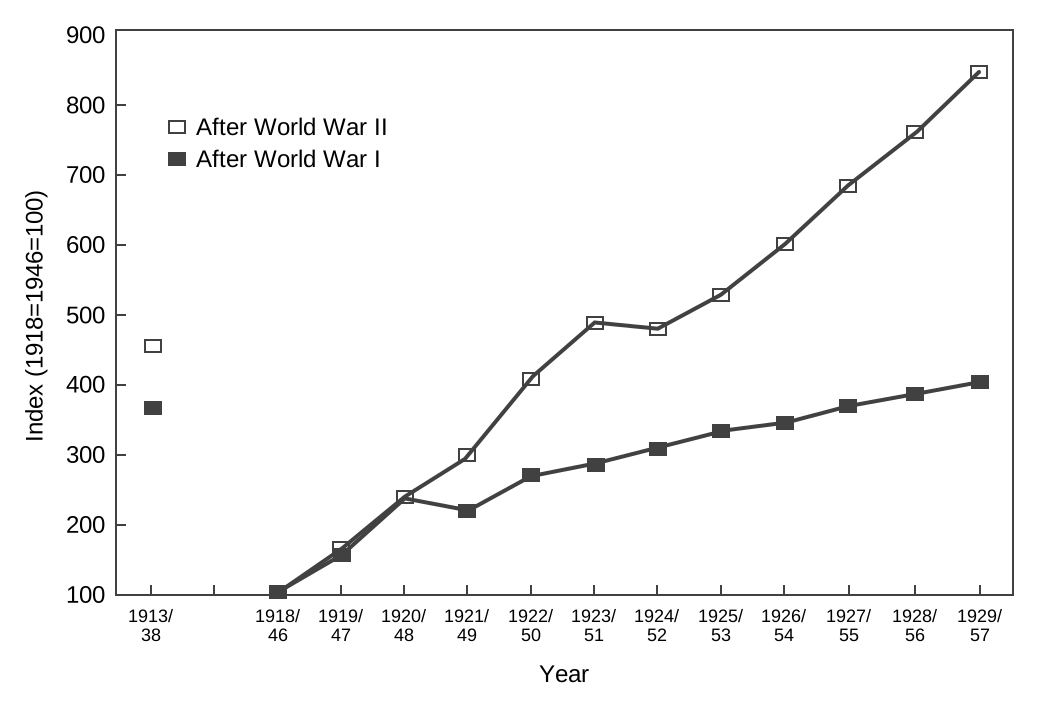
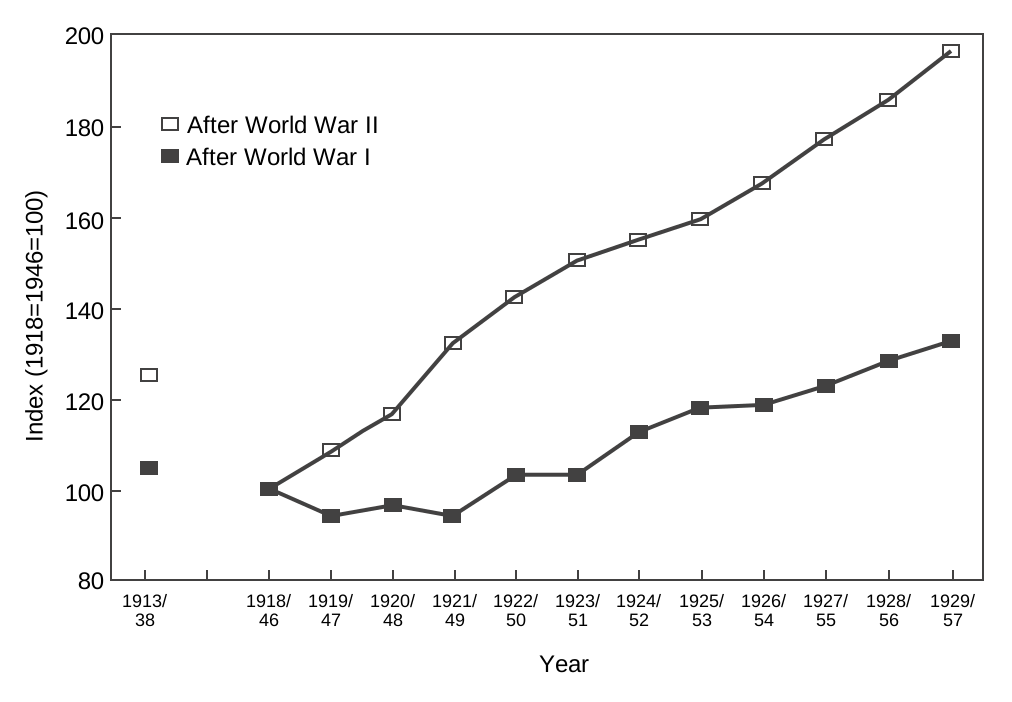
Freeing Europe’s regional and international trade from government restrictions permitted economies to take advantage of specialization according to their comparative advantage, and thereby expand more rapidly.
The policy implications are clear. Lowering trade restrictions is a “win-win” situation, especially when these are lowered between countries with different comparative advantages. The critical issue is that opening up trade will make a country’s citizens better off in the aggregate, but within each country there will always be some losers (such as Kazakh winemakers, for example). The key insight is that the winners always gain more than the losers so the issue is how to build a consensus that will make everyone better off.