Element 2.5: Monetary Stability
“The way to crush the bourgeoisie is to grind them between the millstones of taxation and inflation.”
Money emerged as a human invention to facilitate trades and reduce transaction costs. Modern money is merely paper or electronic digits indicating funds in a financial account. While neither paper nor digital money has any intrinsic value, almost everyone wants more of it. Have you ever wondered why?
Video:
Money performs three important functions that make it valuable. First, money is a medium of exchange. It provides a common denominator that makes it easier for people to exchange goods, services, and resources. Second, money serves as a store of value. It makes it possible for people to shift purchasing power to the future and conduct exchanges across time periods. Third, it provides a unit of account that makes it possible for people to keep track of benefits and costs. By performing these three functions, money increases the gains from trade and facilitates investments that make larger outputs possible.
Money’s contribution to the economy is directly related to the stability of its value. In this respect, money is to an economy what language is to communication. Without words understood clearly by both speaker and listener, communication is difficult. So it is with money. If money does not have a stable and predictable value through time, borrowers and lenders find it difficult to arrive at mutually agreeable terms for loans because saving and investing involve additional risks, and uncertainty escalates. All of this makes transactions that extend over time less likely. When the value of money is unstable, many potentially beneficial exchanges do not occur, reducing output, income, and investment.
When the money supply is constant or increases at a slow, steady rate (similar to the growth of output), the purchasing power of money will be relatively stable. In contrast, when the supply of money expands rapidly compared to the output of goods and services, the general level of prices will rise and the purchasing power of each unit of money will decline.
An increase in the general level of prices is known as inflation. It is important to note that inflation is not merely an increase in the price of a few items such as gasoline, meat, and air travel. It is a general increase in prices across a large bundle of goods and services.
How is inflation measured? The consumer price index (CPI) is the most widely used measure of inflation. The CPI reflects the cost of purchasing the bundle of goods and services consumed by the typical household. When, on average, prices rise, the cost of purchasing this bundle increases, pushing the CPI upward by a proportional amount.
The CPI is reported monthly, and the annual inflation rate is merely the percent increase in the index during the past twelve months. Of course, as prices rise, the purchasing power of money declines, reducing the quantity of goods and services households can buy with their income. Thus, inflation can also be thought of as a decline in the purchasing power of money.
The primary cause of inflation is rapid growth in the supply of money. The money supply, narrowly defined, is the total of the nation’s currency plus bank deposits immediately available (via a bank transfer or a debit card) held by individuals and businesses. A broader definition of money would also include savings deposits held at financial institutions.(54)
Central banks, such as the Federal Reserve Bank (the “Fed”) in the United States or the European Central Bank in the Eurozone, are responsible for the control of the money supply. When working well, these central banks pursue key objectives to promote economic stability and growth. These goals include maintaining price stability and achieving full employment. In order to be successful, central banks need to be able to operate independently from governments. Otherwise, their primary responsibilities may be subverted by politicians who, often with short-run time horizons are tempted to force the bank to create too much money in order to finance government expenditures (which voters like) without raising taxes (which voters hate).
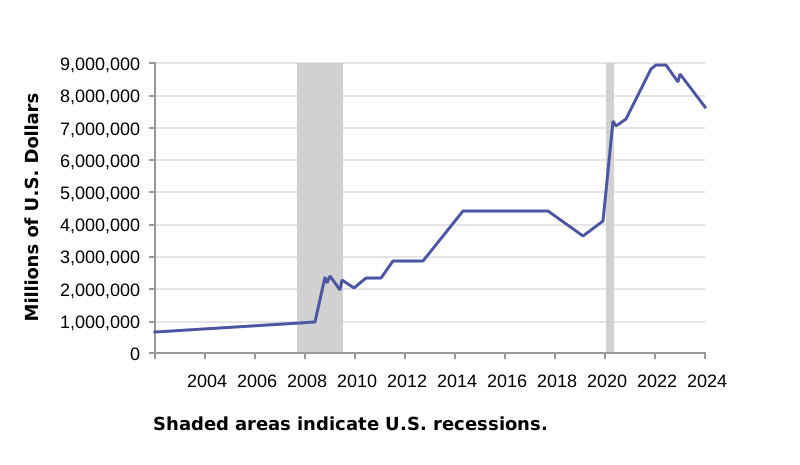
How can the central bank change the supply of money? If you look at the currency of almost any country the bill will say that it is printed by that country’s central bank (or the ECB for countries in the Euro zone). Obviously, one way to increase the money supply is simply to run the printing presses faster. This is typically what happens in the worst periods of hyperinflation discussed below. In the modern world, however, central banks have a much more powerful tool to affect the money supply and the rate of inflation. When an ordinary citizen or firm wants to purchase an asset they have to pay for it by transferring funds to the seller. Central banks, however, because they have the power to create money can simply “pay” for their purchases by adding a credit to the bank account of the seller. When the central bank wants to increase the supply of money and lower interest rates it simply buys assets (usually government debt) from the public and, thereby increase the supply of money in circulation. They are called open market operations. Exhibit 6 below shows the increase in assets of the Fed between 2003 and 2024.
Source: Board of Governors of the Federal Reserve System (US) - fred.stlouisfed.org
Countries that persistently expand the supply of money more rapidly than the growth of output experience inflation. Historically, this linkage between rapid growth of the money supply and inflation has been one of the most consistent relationships in all of economics.(55)
Exhibit 7: Monetary Growth and Inflation, 1996-2021
| Average Annual Growth Rate of Money Supply (%) | Average Annual Rate of Inflation (%) | |
| Rapid Growth of the Money Supply | ||
| Belarus | 58 | 41.1 |
| Turkiye | 37.3 | 25.9 |
| Romania | 25.8 | 19.1 |
| Kazakhstan | 25.8 | 9.7 |
| Ukraine | 25.6 | 15.3 |
| Azerbaijan | 23 | 5.7 |
| Georgia | 22.7 | 6.9 |
| Kyrgyz Republic | 20.8 | 10.1 |
| Armenia | 19.6 | 4.6 |
| Slow Growth of the Money Supply | ||
| United Kingdom | 8.2 | 2 |
| Sweden | 7.6 | 1.2 |
| United States | 7.1 | 2.2 |
Source: World Bank Open Data. worldbank.org
- Note: Analyzed variables are "Inflation, consumer prices (annual %)" and "Broad money growth (annual %)".
Exhibit 7 illustrates the linkage between the growth of the money supply and inflation. Note how countries that increased their money supply at a slow annual rate experienced low rates of inflation during 1996–2021. This was true for large high-income countries like the United States, as well as for smaller ones like Sweden and the United Kingdom. During 1996–2021, the money supply grew at an annual rate between 19 and 26 percent in Armenia, the Kyrgyz Republic, Georgia, Azerbaijan, Ukraine, Kazakhstan, and Romania. Note that all these countries experienced higher annual inflation rates compared to countries with slow growth of the money supply. More rapid rates of monetary growth, in the case of Turkiye and Belarus, led to even higher average annual rates of inflation, 25.9 and 41.1 percent, respectively. As Exhibit 7 illustrates, there is a close relationship between rapid monetary expansion and high rates of inflation when measured over lengthy time periods.
Video:
Inflation adversely affects income levels and living standards. As noted above, money is to an economy what language is to communication. Prices convey important information. They help a consumer decide whether to purchase a product, and they tell producers whether consumers’ purchases are worth what they cost to make. In this way, prices direct decision-makers to produce goods and services people value highly relative to cost. During inflationary periods the prices of some goods will change more rapidly than others. Thus, inflation distorts the information provided by prices.
Moreover, high rates of inflation are nearly always accompanied by large and erratic fluctuations in the inflation rate. When prices increase 10 percent one year, 5 percent the next year, 15 percent the year after that, and so on, activities that depend on accurate identification of the value of money over time, such as investing, involve greater risk. Unexpected changes in the inflation rate can generate misleading information and quickly turn apparently productive projects into counterproductive investments and personal economic disasters. Rather than dealing with these additional risks, many entrepreneurs and investors will simply forgo capital investments and other transactions involving long-term commitments. As a result, gains from investment and other business activities will be undermined and output will fall short of its potential.
When central bank policies achieve price stability, they reduce uncertainty and provide the foundation for full employment. How can central bank policy best achieve price stability? The central banks of Armenia, Azerbaijan, Georgia, Belarus, Kazakhstan, Moldova, Russia, Ukraine, and Uzbekistan set their inflation targets ranging from 3% to 6% for the years 2021-2022. In contrast, high-income countries such as the United States, United Kingdom, South Korea, Sweden, and Norway have established a uniform inflation target of 2% for the same period.(56) The inflation target provides the central banks with clear signals for the conduct of monetary policy. If the rate of inflation rises above the target, this is a signal for the central bank to shift to a more restrictive monetary policy, raising interest rates. Correspondingly, if the inflation rate falls below the target, this signals the need to shift to a more expansionary policy.
However, inflation targeting is tricky. It requires knowledge of inflation, actual output, and potential output. Some economists believe that rather than targeting the inflation rate, it would be better for the central bank to target nominal GDP growth—the sum of real GDP growth and inflation. For example, suppose the Fed adopted a 5 percent target for nominal GDP growth. If nominal GDP growth was greater than 5 percent, the Fed would shift toward a more restrictive policy. In contrast, if nominal GDP growth fell below the 5 percent target, the Fed would be more expansionary.
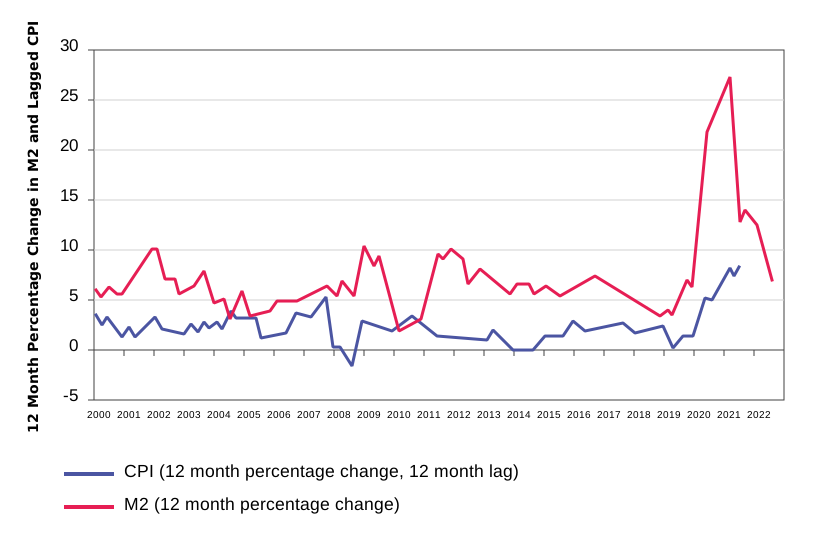
Exhibit 8 shows the relationship between the growth rate of the money supply (using the broad definition, called M2(57)) and the inflation rate in the US between 2000 and 2022. Both are measured as a twelve-month moving average, which is merely the percent change during the past twelve months. Because a few quarters generally elapse before a shift in monetary policy affects prices, the inflation rate data are lagged by twelve months. During the period 2000–2019, the growth rate of the money supply grew at an average of 6 percent and remained between 3 percent and 10 percent throughout this period. This growth rate of the money supply was accompanied by an average inflation rate of 2 percent.
With interest rates exceedingly low, monetary authorities world-wide were able to expand the money supply a little more rapidly than the growth of output without causing inflation. Low interest rates reduce the opportunity cost of holding money, and therefore people are willing to hold larger money balances and the turnover rate of money is lower. The turnover rate (economists call this velocity) is the number of times a unit of money is used to purchase goods and services.
Video:
During this period, demographic factors pushed interest rates downward. In high-income countries, the share of population in the younger age categories (for example, less than age forty) in which people are generally net borrowers, has declined, while the share in older age categories, where people are generally net lenders (for example, ages fifty to seventy-five), has increased. This change has reduced the demand and increased the supply of money, pushing interest rates downward throughout the world. In turn, the lower interest rates have caused the turnover rate of money to decline, making it possible for the monetary authorities to expand the money supply a little more rapidly without causing inflation.
Sources
Federal Reserve Bank of St. Louis, M2 [M2SL], retrieved from FRED, Federal Reserve Bank of St. Louis; fred.stlouisfed.org/M2SL; (retrieved July 5, 2022)
Federal Reserve Bank of St. Louis, Consumer Price Index for All Urban Consumers: All Items in U.S. City Average [CPIAUCSL], retrieved from FRED, Federal Reserve Bank of St. Louis, fred.stlouisfed.org/CPIAUCSL; (retrieved July 5, 2022)
All of this changed when COVID hit. During 2020–2022 the money supply growth rate soared to a rate far greater than the growth of real output (nominal GDP adjusted for inflation). Just as theory predicted, soon after the surge in money growth, the inflation rate soared, in the US, reaching 9% during the first half of 2022.
While 9% inflation may seem high for those who are used to stable prices, at various times monetary authorities have created far greater problems. In Yugoslavia in 1994 prices doubled every 36 hours. A loaf of bread that cost 10 dinars on Monday morning would sell for over 300 dinars a week later. This led the country to abandon its currency and adopt the German mark. The situation in Hungary in 1946 was even worse. For a time, prices doubled every 15 hours. In Ukraine in 1993 prices increased well over 400-fold.
While excessive monetary expansion is the primary cause of inflation, monetary contraction often leads to economic instability in the form of deflation and recessions. For example, the Fed permitted the money supply to fall by 30 percent during 1929–1933. This led to the American economy shrinking by 29% in real terms and unemployment rising to 25% of the workforce. Many economists believe that the huge 1929–1933 contraction in the money supply was the primary cause of the Great Depression. There were other contributing factors, including the large tariff increases of 1930 and the huge 1932 increase in income tax rates. However, even if perverse monetary policy was not the primary cause, it was certainly a major contributor to the severity and length of the Great Depression.
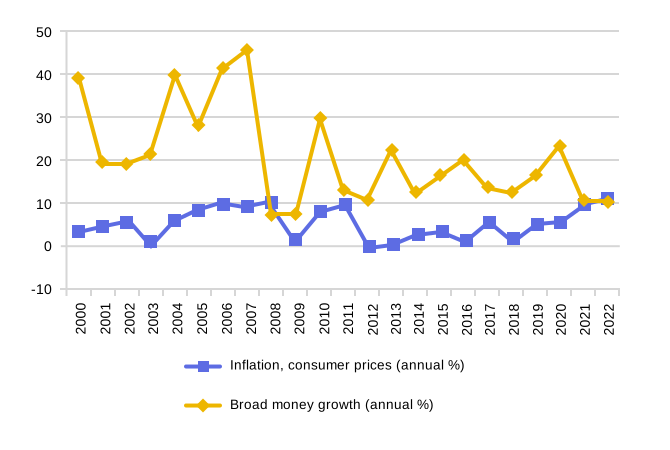
The link between money supply and inflation is also clear in a small, developing, upper-middle-income country like Georgia. Exhibit 9 illustrates this relationship by comparing the growth rate of the money supply (using the broad M2 definition) to the inflation rate from 2000 to 2022 in Georgia. Between 2000 and 2007, the money supply expanded by an average of 32 percent, which was followed by an average inflation rate of 6.7 percent from 2001 to 2008. This comparison is more relevant when using lagged data, as changes in monetary policy take time to impact prices. From 2008 to 2021, the money supply grew at a slower average rate of 16.4 percent, leading to a lower average inflation rate of 4.7 percent from 2009 to 2022.
Source: World Bank Open Data. data.worldbank.org.
Historically, monetary instability has been a major cause of economic disturbances. Why has this been the case? At various times, several different factors have played a role, but two deserve special mention. First, monetary policymakers often confront strong political pressures to finance government spending with money creation. Politicians do not like to levy taxes, because this imposes a visible cost on voters. Thus, politicians will often pressure monetary policymakers to finance spending increases by expanding the money supply so they will not have to raise taxes. Second, as previously mentioned, there is a time lag of six to eighteen months between a shift in monetary policy and the time when the change exerts an impact on output and employment. Sometimes the time lag will be even longer. Therefore, when policymakers constantly shift policies in an effort to minimize economic instability, the lengthy and unpredictable time lags will result in monetary policy errors that increase rather than reduce economic instability.
It is difficult to overstate the importance of monetary and price stability. While monetary stability does not guarantee growth and prosperity, without it, strong growth and economic stability will be impossible. If investors and other business decision-makers can count on monetary policymakers to maintain price stability, a potential source of uncertainty is eliminated. When monetary policymakers follow policies that keep the inflation rate low and relatively steady, they have done their part to establish the monetary framework for economic growth and prosperity.