Element 1.6: Prices Align Buyers and Sellers
“Lowering prices is easy. Being able to afford to lower prices is hard.”
Market prices influence the choices of both buyers and sellers. When the price of a product rises, purchasing the item is more expensive and consumers normally choose to buy less. Thus, there is a negative relationship between the price of a good or service and the quantity demanded. This negative relation is known as the law of demand.
For sellers, the rise in the price of a product brings extra revenue that makes them willing to supply more. Thus, there is a positive relationship between the price of a good and the quantity producers will supply. This positive relationship is known as the law of supply.
Economists often use graphics to illustrate the relationships among price, quantity demanded, and quantity supplied. When doing so, the price of a good is placed on the vertical y-axis and the quantity per unit of time (for example, a week, month, or year) on the horizontal x-axis. Using ice cream as an example and the Georgian Lari (GEL) as the currency, Exhibit 2 illustrates the classic demand-and-supply graphic. The demand curve indicates the various quantities of ice cream that consumers will purchase at alternative prices. Note how the demand curve slopes downward to the right, indicating that consumers will purchase more ice cream as its price declines. This is merely a graphic representation of the law of demand. (Note, that a “curve” is any set of points along a line. This means that a straight line is simple one type of curve. In other works, demand and supply curves may not be shown as a straight line. Don’t get confused!)
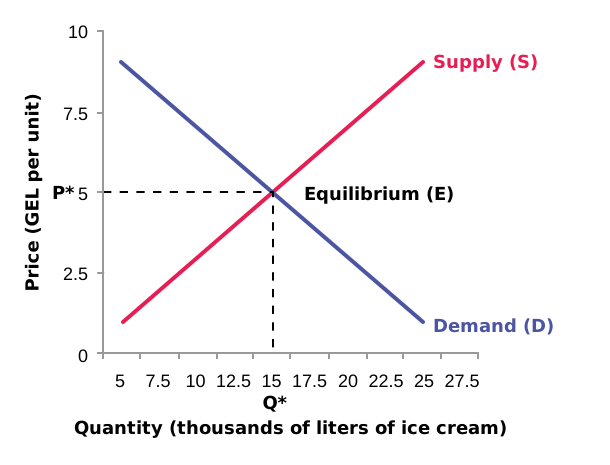
The supply curve indicates the various quantities of ice cream that producers are willing to supply at alternative prices. As Exhibit 2 illustrates, the curve slopes upward to the right, indicating that producers will be willing to supply larger quantities at higher prices. The supply curve provides a graphic representation of the law of supply.
Now for a really important point: The price will tend to move toward a level—GEL 5 per liter of ice cream in our example—that will bring the quantity demanded into equality with the quantity supplied. At the equilibrium price of GEL 5, consumers will want to purchase 15,000 liters of ice cream per day. This is the same quantity that ice cream producers are willing to supply. Price coordinates the choices of both consumers and producers of ice cream and brings them into balance.
If the price is higher than GEL 5, for example GEL 7, producers will want to supply more ice cream than consumers will want to purchase. This means that at GEL 7, producers will be unable to sell as much as they would like. Inventories will rise, and this excess supply will lead some producers to cut their price to reduce their inventories. The price will tend to decline until the GEL 5 equilibrium price is reached. As long as the price is above equilibrium, market forces will push the price downward.
Correspondingly, if the price of ice cream is less than GEL 5, for example GEL 3, consumers will want to purchase more than producers are willing to supply. This GEL 3 price generates excess demand, leaving producers without adequate inventories. Upward pressure on price will move it back toward the equilibrium of GEL 5. The choices of buyers and sellers will be consistent with each other only at the equilibrium price, and the market price will gravitate toward this level.
The auction system on eBay illustrates the operation of demand and supply in a setting that is familiar to many. On eBay, sellers enter their reserve prices—the minimum prices they will accept for goods. Buyers enter their maximum bids—the maximum prices they are willing to pay. The auction management system will bid on behalf of the buyers in predetermined monetary increments. Bidding ensues until the trading period expires or a person agrees to pay the stated “Buy It Now” price. Exchange occurs only when buyers bid a price greater than the seller’s minimum asking price. But when this happens, an exchange will occur, and both the buyer and seller will gain. Remember, voluntary trade is mutually beneficial.
Though somewhat less visible than the electronic market eBay, the forces of demand and supply in other markets work similarly. The height of the eBay demand curve indicates the maximum amount the consumers are willing to pay for another unit of the good, while the height of the supply curve shows the minimum price at which producers are willing to supply another unit. When the price is between the maximum the consumer is willing to pay and the minimum offer price of a seller, potential gains from trade are present. Moreover, when the equilibrium price is present, all potential gains from exchange will be realized by both consumers and producers.
Marginal thinking explains why, when the equilibrium price is present, buyers and sellers will have an incentive to make mutually advantageous exchanges and the outcome will be efficient. Consumers purchase only those units that bring them more value than the actual price. Similarly, producers supply only those units that can be sold at a price that covers cost. When the equilibrium price is present, units will be produced and purchased as long as the value of the good to consumers exceeds the cost of the resources required for their production. The implication: market prices not only bring the quantity demanded and quantity supplied into balance, but they also direct producers to supply those goods that consumers value more than their cost of production. This holds true in any market.
Of course, we live in a dynamic world. Through time, changes will occur. They will alter the demand and supply of goods and services. Factors such as consumer income, prices of related products, expectations about future prices, government policy changes, and the number of consumers in the market area will influence the demand for a good. Changes in any of these factors will change the amount of a good consumers will want to purchase at the various possible prices. Put another way, changes in these factors will cause a change in demand, a shift in the entire demand curve.
It is important to distinguish between a change in demand—a shift in the entire demand curve—and a change in quantity demanded, a movement along a demand curve as the result of a change in the price of the good. It is important note to students: failure to distinguish between a change in demand and a change in quantity demanded is one of the greatest challenges students face. Questions on this topic are favorites of many economics instructors, so make sure you understand this difference!
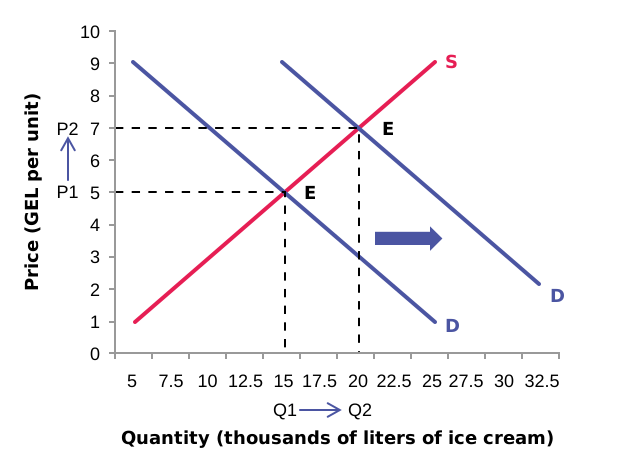
Exhibit 3 illustrates the impact of an increase in demand on the market price of a good. Suppose there is an increase in consumers’ incomes or a rise in the price of frozen yogurt, a common substitute for ice cream. These changes will increase the demand for ice cream, causing the demand curve to shift to the right, from D1 to D2. In turn, the stronger demand will push the equilibrium price of ice cream upward from GEL 5 to GEL 7. At the new higher equilibrium price, the quantity demanded by consumers will once again be brought into balance with the quantity supplied by producers. Note: The increase in demand (the shift in the entire demand curve) will result in an increase in the quantity supplied from 15,000 to 20,000 (a movement along the existing supply curve).
A reduction in consumers’ incomes or lower frozen-yogurt prices would exert the opposite impact. These changes would reduce the demand for ice cream (shift the demand curve to the left), lower the price, and reduce the equilibrium quantity exchanged.
Video:
Now let’s turn to the supply side of a market. Changes that alter the per-unit cost of supplying a good will cause the entire supply curve to shift. For example, an improvement in technology, lower prices for the resources used in production, or subsidies to the producers will increase supply, causing the entire supply curve to shift to the right. In contrast, changes that make it more expensive to produce the item—such as higher prices for the materials used to produce the item or higher taxes imposed on the producers—will reduce supply, causing the supply curve to shift to the left.
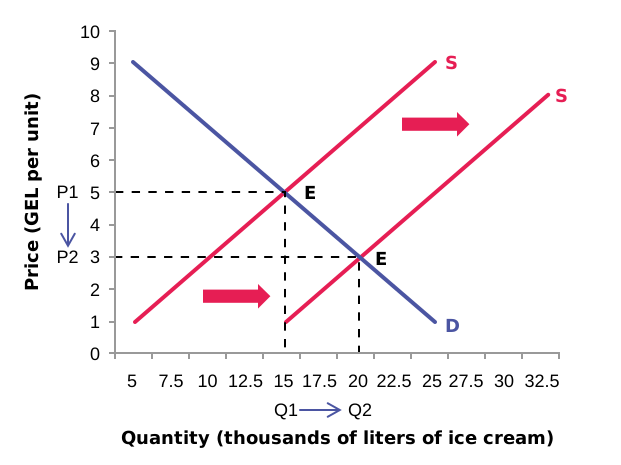
Suppose there is a reduction in the prices of cream and milk, ingredients used to produce ice cream. What impact will these resource price reductions have on the supply and market price of ice cream? If your answer is that supply will increase and the market price will decline, you are correct. Exhibit 4 illustrates this point within the demand-and-supply framework. The lower prices of cream and milk will reduce the per-unit cost of producing ice cream, causing the supply curve to shift to the right (from S1 to S2). As a result, the equilibrium price of ice cream will decline from GEL 5 to GEL 3. At the new lower price, the quantity demanded will increase and once again equal the quantity supplied at 20,000 liters per day. Note: The increase in the supply—that is, the shift of the entire curve — lowered the price of ice cream and increased the quantity demanded, a movement along the existing demand curve.
What if changes had occurred that increased the cost of producing ice cream—for example, higher prices for the ingredients? Then the results would be just the opposite: a decrease in supply—that is, a shift in the curve to the left—an increase in the price of ice cream, and a reduction in the quantity exchanged.
Market adjustments like the ones outlined here do not take place instantaneously. It takes time for both consumers and producers to adjust fully to new conditions. In fact, the adjustment process we are describing is constantly changing in a dynamic world.
Technological developments make the dynamism and price adjustments reacting to shifts in demand and supply even more noticeable. Have you taken an Uber or Yandex ride recently? The price for a given ride can vary minute-to-minute. On a rainy day more people decide not to walk (demand goes up) and more drivers stay home (supply goes down) so the price rises.
The impact of changes in demand and supply and factors that underlie shifts in these curves are central to the understanding of the market process. Demand-and-supply analysis will be utilized again and again throughout this book.